
Deel vs Remofirst
Choosing between Deel and Remofirst comes down to a fundamental trade-off: do you pay for comprehensive platform capabilities or optimise for lower EOR costs? This decision gets more complex when you factor in your Finance team’s risk tolerance and your Legal department’s compliance requirements.
We tested both platforms across real hiring scenarios and found the cost difference is genuine – but so are the capability gaps. Remofirst charges 25-40% less for basic EOR services. Deel provides deeper compliance infrastructure and broader platform tools.
The right choice depends on whether you’re running a focused EOR pilot or building long-term global operations.
Should you choose Deel or Remofirst?
Choose Deel for contractor payments, global payroll, and EOR in one platform with proven compliance depth; choose Remofirst for pure EOR services at lower cost where you can accept narrower capabilities and newer infrastructure.
| Compared |
DDeel
|
RRemofirst
|
|---|---|---|
| Score (Whichapp composite, /10) | 9.1 | 8.6 |
| EOR base pricing | $599$599/employee/month | $199$199/employee/month |
| Country coverage | 150+ countries | 185+ countries |
| Contractor payments | Yes (free tier available) | Yes ($25/contractor; free to manage) |
| Global payroll | Yes (payroll in 130+, native engine 50+) | No |
| Founded | 2019 | 2021 |
| Compliance model | Mix of owned and partner entities | Primarily partner network |
| Support model | 24/7 chat, dedicated CSM (Growth+) | 24/7 support + dedicated account manager |
| HRIS integrations | 80+ native integrations | Two-way ADP connector + BambooHR + API |
The verdict
Choose Deel if
You need contractor payments, global payroll, and EOR in one platform with proven compliance depth.
Choose Remofirst if
You want pure EOR services at lower cost and can accept narrower capabilities and newer infrastructure.
EOR pricing
Deel
From $599/month.
Remofirst
From $199/month. Real costs often 2-3x higher with benefits.
Key difference
Deel
Operates as a technology platform with global reach.
Remofirst
Focuses solely on affordable EOR.
Compliance depth
Deel
Has 7+ years of regulatory history.
Remofirst
Launched in 2021 with limited public track record.
Bottom line · Remofirst works for cost-sensitive EOR pilots. Deel fits companies building comprehensive global operations. Pricing and coverage reviewed April 2026.
How Do Deel and Remofirst Compare Feature by Feature?
We mapped capabilities across both platforms to identify where the trade-offs become operationally significant. The gaps appear most clearly in compliance infrastructure, support depth, and platform integration.
Real cost analysis
5-employee scenario across UK, Germany, Philippines
Deel total monthly cost: $4,245 (includes EOR fees, employer taxes averaged at 30%, benefits administration)
Remofirst total monthly cost: $2,745 (same components). The $1,500/month difference scales linearly – at 25 employees, you save $7,500 monthly with Remofirst.
| Capability | DDeel |
RRemofirst |
|---|---|---|
| Owned entities | 100+ countries (owned entities) | 0 owned entities (100% partner network) |
| Benefits administration | Automated enrollment | Manual coordination |
| Onboarding speed | 2-5 business days | 1-3 business days |
| Contract flexibility | Custom amendments | Standard templates |
| IP protection | PIIA included | Basic assignment |
| Equity handling | Yes (most countries) | Limited support |
| Background checks | Integrated ($75+) | Third-party only |
Key Differences Between Deel and Remofirst
The two platforms split on five operational dimensions. Deel offers broader integrations, deeper contractor tooling, and heavier automation in Tier 1 markets. Remofirst undercuts on per-employee EOR fees and matches Deel on raw onboarding speed for teams that want a leaner platform without the integration overhead.
Your team size, geographic mix, and tolerance for self-serve workflows decide the winner more than the sticker price. The dedicated sections below break down each trade-off.
What Does Deel Bring to This Comparison?
Deel positions itself as the “all-in-one” global workforce platform. They started with contractor payments in 2019 and expanded into EOR and global payroll. The platform now handles the full employment lifecycle.
Beyond EOR services, Deel provides contractor payment infrastructure (including a free tier), global payroll across 130+ countries (native in-house payroll engines in 50+), immigration support, and equity management tools.
See our full Deel review for the detailed breakdown.
What Does Remofirst Bring to This Comparison?
Remofirst launched in 2021 with a focused value proposition: make EOR services affordable for small and mid-market companies. They strip away platform features to deliver lower pricing.
The company provides employer of record services – employment contracts, payroll processing, tax compliance, and basic benefits administration – plus a contractor-management product (free to manage, $25 per contractor to pay). What it leaves out is owned-entity global payroll and the deeper supplementary HR tooling Deel bundles in.
See our full Remofirst review for the detailed breakdown.
How Do Deel and Remofirst Compare on Features?
Feature comparison reveals the strategic divide. Deel invests in platform capabilities that create switching costs. Remofirst maintains feature minimalism to preserve pricing advantage.
Employer of Record Services
Both providers handle core EOR requirements – employment contracts, payroll, tax filings, and compliance. The differentiation appears in execution depth.
Deel automates more of the process. Employee self-service portals, automated tax calculations, and integrated benefits enrollment reduce manual work.
Remofirst requires more email coordination and manual data entry. Each benefits change triggers an email chain.
For complex employment scenarios (equity grants, retention bonuses, relocation support), Deel’s infrastructure handles more edge cases. Remofirst often requires workarounds or says no.
Contractor Management
Deel includes full contractor payment infrastructure with compliance features. Contractors invoice through the platform, get paid in 100+ currencies, and receive tax documents automatically, with a free management tier and a Contractor of Record option (from $325/contractor/month) that assumes the misclassification and IR35 liability.
Remofirst also manages contractors: it is free to onboard and manage them and charges $25 per contractor per month to run payments, with no setup, minimums or annual contract. What it lacks is Deel’s depth, with no Contractor of Record indemnity tier and a thinner compliance wrapper.
So both can pay your overseas contractors; the real question is whether you need the classification protection and currency breadth Deel layers on top.

How Do Deel and Remofirst Compare on Pricing?
Pricing comparison requires looking beyond headline rates to total employment costs. We modelled real scenarios to understand where savings materialise and where hidden costs emerge.
EOR Pricing
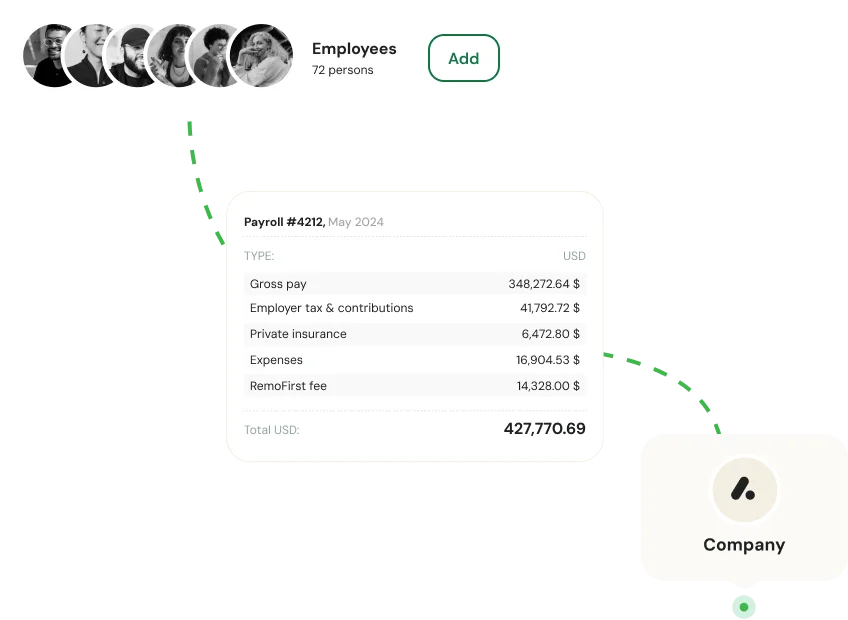
Deel’s standard EOR pricing starts at $599/employee/month, with volume discounts available above 20 employees (the exact rate is quoted, not published). Growth plan ($99/month base) unlocks dedicated support.
Remofirst charges $199/employee/month with minimal volume discounting. Their model assumes margin comes from volume, not enterprise upsells.
Remember these are base fees. Employer taxes (15-45% of salary), benefits costs, and setup fees add substantially to both.
Your Finance team needs the real number, not the marketing price.
Contractor and Payroll Pricing
Deel keeps a free contractor-management tier, with paid contractor plans from $49/contractor/month for the full compliance feature set, and its Global Payroll for owned-entity countries runs from $29/employee/month.
Remofirst undercuts here too: contractor management is free to set up and $25/contractor/month to pay, with no setup or termination fees. It has no owned-entity global payroll product, so for consolidating payroll across your own entities, Deel stands alone.
How Do Deel and Remofirst Compare on Compliance?
Compliance comparison reveals the clearest strategic difference. Deel invests in owned infrastructure.
Remofirst leverages partner networks. Your risk tolerance determines which model fits.
Entity Model
We verified Deel operates owned entities in 100+ countries including all major markets (UK, Germany, France, Singapore, Australia), with roughly 40% of its covered markets served through vetted partners. These entities date back several years with established regulatory relationships.
Remofirst runs a 100% partner model across all 185+ countries. They hold zero owned entities; every hire goes through a vetted in-country partner.
This model works but adds a layer between you and actual employment infrastructure. When compliance questions arise, you’re playing telephone.
Legal Infrastructure
Deel’s localised contracts include IP protection (PIIA), non-compete management, and customisation options. Their legal team updates templates quarterly based on regulatory changes.
Remofirst provides standard employment contracts with basic IP assignment. Customisation requires external legal review in most countries.
Updates happen but on longer cycles. You might operate on outdated templates for months.
In the UK, Deel runs HMRC-recognised payroll from its own wholly owned UK entity: PAYE registration, RTI reporting via FPS and EPS, pension auto-enrolment through Penfold at the statutory 3% of qualifying earnings, and all seven statutory pay types. Remofirst reaches the same outcome through its UK partner, applying employer National Insurance (now 15%) and pension auto-enrolment, though the partner, not Remofirst, is the legal employer.
How Do Deel and Remofirst Compare on Country Coverage?
Coverage comparison requires distinguishing between marketing claims and operational reality. Deel covers 150+ countries; Remofirst 185+. Service depth varies significantly by location.
Total Country Coverage
Deel covers 150+ countries with a bias toward markets where they’ve built owned infrastructure. They typically launch with deeper capability but expand slower.
Remofirst covers 185+ countries through their partner network, manages contractors in 150+, and runs visa and work-permit support in 110+. They’ll often support countries Deel doesn’t, but with baseline services only.
More flags on the coverage map doesn’t mean better service in each location.
Strength in Key Hiring Markets
In primary hiring destinations (UK, Canada, India, Philippines, Poland, Brazil), both providers deliver solid service. Deel’s advantages show in faster processing and fewer manual workarounds.
For the US specifically, both handle state registrations and compliance well. Deel processes faster (48-72 hours vs 5-7 days) and handles more complex scenarios like multi-state employees.
How Do Deel and Remofirst Compare on Support?
Support comparison highlights operational philosophy differences. Deel invests in proactive support infrastructure. Remofirst maintains cost efficiency through reactive email-based service.
Account Management and Service Model
Deel assigns customer success managers to Growth plan accounts ($99/month + per-employee fees). These CSMs proactively monitor account health and flag issues before they escalate.
We’ve seen CSMs catch benefits enrollment problems before employees noticed.
Remofirst takes a more hands-on line than its budget price suggests: it advertises 24/7 customer service with a dedicated account manager and live chat on every account, not just at enterprise scale.
Reviewers note the reality can lag the promise during onboarding rushes, but the model is more personal than a pure ticket queue.
Support Channels and Response Times
Deel offers 24/7 chat support with <2 hour average first response based on review analysis. Phone support available for urgent issues on higher-tier plans.
Remofirst publishes 24/7 support with online chat and a named account manager. Reviews still indicate 24-48 hour response times on complex tickets, with longer delays during employee onboarding rushes.
When your German employee’s tax code is wrong and payroll runs tomorrow, those hours matter.
Which Should You Choose: Deel or Remofirst?
The decision framework depends on your operational maturity, risk tolerance, and growth trajectory. Neither provider fits every scenario optimally.
Choose Deel If
- You’re building long-term global operations with mixed workforce types. The platform investment pays off when you need contractor payments, EOR services, and future entity establishment through one system.
- You require deeper compliance confidence for regulated industries or complex employment scenarios. Deel’s infrastructure and track record reduce Legal team friction during vendor approval.
- Picture the procurement meeting: “Yes, they cost more. They also have 7 years of compliance history and owned entities in our top 5 markets.” That’s an easier sell than explaining partner networks.
- You value operational efficiency over pure cost savings. The automation, integrations, and unified workflows save administrative overhead that often exceeds the price premium.
Choose Remofirst If
- You’re running a focused EOR pilot with 2-10 employees in standard markets. The cost savings are material at small scale, and limited features won’t constrain you.
- Your budget genuinely cannot accommodate $599/employee/month. Remofirst makes international hiring possible for cash-constrained startups that would otherwise stay domestic.
- Better to hire internationally with constraints than not hire at all.
- You already have established contractor payment and HR systems. If you only need pure employment infrastructure, paying for Deel’s platform features wastes budget.
Consider an Alternative If
- You need deeper local expertise in specific regions. Providers like Velocity Global or Atlas offer stronger infrastructure in certain markets than either Deel or Remofirst.
- You’re hiring primarily in Latin America. Regional specialists like Ontop provide better local support and pricing for concentrated geographic hiring.
- You want white-glove enterprise service. Providers like Safeguard Global offer more customisation and hands-on support for complex global programs.
- Sometimes the best choice is neither option on the table.
What Are the Best Alternatives to Deel and Remofirst?
For companies where neither provider fits perfectly, these alternatives address specific gaps in the Deel/Remofirst comparison.
- For companies prioritising compliance confidence through owned infrastructure.
- For companies already using enterprise HRIS systems.
- For distributed startups wanting modern user experience with responsible pricing.
Check pricing
Provider links may be affiliate links where programmes are live.
Deel vs Remofirst: Frequently Asked Questions
How do setup and onboarding times compare between Deel and Remofirst?
Deel typically onboards employees in 2-5 business days for standard cases. Remofirst is comparable, averaging 1-3 business days with full documentation and 24-48 hours in its fastest corridors.
On raw speed the two are close; Deel’s edge is automation, with self-service portals and automated compliance checks that cut manual back-and-forth on complex or multi-country hires rather than simple ones.
Can I use both providers simultaneously for different employee groups?
Yes, some companies use Remofirst for cost-sensitive markets and Deel for complex jurisdictions or where contractor payments are needed. This hybrid approach requires managing two vendor relationships and reconciling data across platforms. It works best when you have clear geographic or workforce-type boundaries between providers.
What happens if I need to terminate an employee through these platforms?
Both providers handle terminations, but execution differs. Deel’s platform calculates severance automatically and manages the full offboarding process digitally.
Remofirst requires more email coordination and manual calculation. In complex termination scenarios (performance issues, restructuring), Deel’s legal team provides more comprehensive guidance included in base pricing.
How We Compared Deel and Remofirst
Whichapp is an independent comparison site for global payroll, EOR, and contractor management platforms. We do not sell these services and do not accept payment for editorial placement. We may earn a commission if you book a demo or request a quote through links on this page. This comparison was produced by our editorial team and was not reviewed or approved by either provider before publication.
Data Sources
- Provider pricing pages for both brands (verified April 2026)
- G2 and Capterra reviews for both brands (Jan–Apr 2026)
- Provider help centre documentation and country guides
- Whichapp provider score composite data (see sources & data)
Research Approach
- Pricing model and total employment cost
- Entity model and compliance infrastructure
- Country coverage depth and quality
- Platform usability and onboarding experience
- Customer support model and response standards
- Verified user feedback from G2 and Capterra
Both providers were assessed across the same six dimensions: pricing model and total employment cost, entity model and compliance infrastructure, country coverage depth and quality, platform usability and onboarding experience, customer support model and response standards, and verified user feedback from G2 and Capterra. Neither provider was engaged for a paid pilot or contract as part of this comparison.
Whichapp Research used in this comparison
- EOR Cost Benchmark: published EOR fee ranges and pricing model disclosure across providers
- EOR vs Entity Break-Even Benchmark: 40-country cost crossover analysis: when EOR becomes more expensive than entity setup