
Rippling Review
Our verdict
Rippling is not really an EOR provider. It is an HR, IT, and Finance platform that happens to offer EOR.
The reason to choose Rippling is never “we need the best EOR.” It is “we need one system for HR, IT devices, expense cards, benefits, and international hiring.” No other provider attempts that unification. Rippling consolidates the operational stack from one trigger: the hire lands, the laptop ships, apps provision, payroll runs, benefits enrol, and the card activates.
Best for unified IT, HR, and global finance.
| Coverage model | Hybrid EOR in 80+ countries via in-country partners |
|---|---|
| Pricing transparency | Low Quote-based EOR; no published rate |
| Integration depth | Very high 600+ third-party integrations, native IT module |
| Security & compliance | High |
Composite is a weighted index across these verified dimensions — see methodology.
What Is Rippling and How Does It Work?
Rippling is a workforce management platform founded in 2016. As of 2025 it raised at a $16.8 billion valuation, serves around 20,000 customers, and is approaching $1 billion ARR. EOR sits inside a full HR, IT, and Finance system built around a single employee record.
What Rippling Does
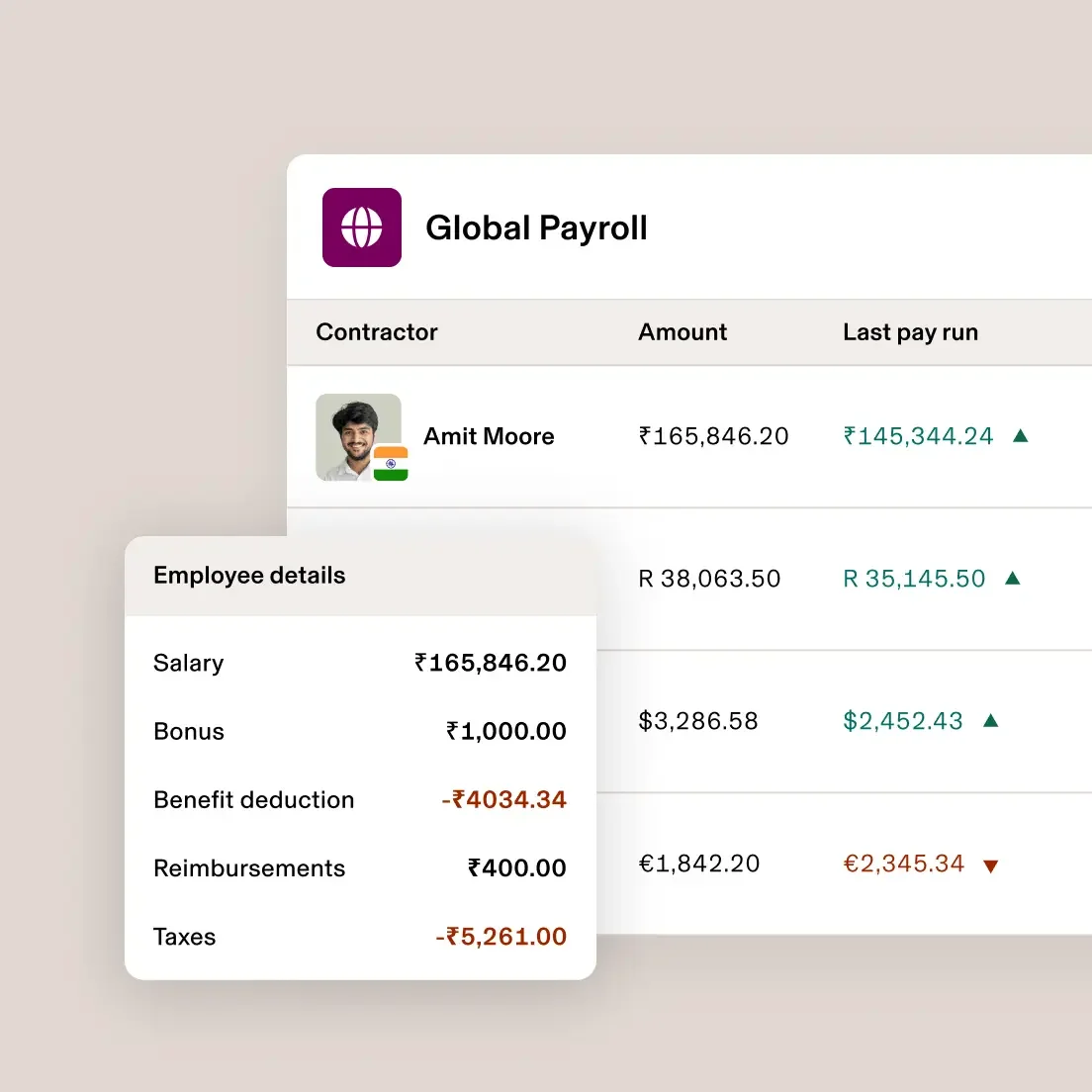
Rippling processes payroll natively in 7 countries (US, Canada, UK, Ireland, France, Australia, India) and via partners in 73 more. It also handles IT devices, app access, benefits, expenses via Rippling Spend, EOR in 80+ countries, and contractors in 185+.
The defining feature is automation. Hire someone and their laptop ships, apps provision, payroll starts, and benefits enrol from one workflow. Its US benefits administration consolidates health insurance, 401(k), and pre-tax FSA and HSA accounts in the same place.
Who Rippling Is Designed For
Rippling targets US-headquartered SMB and mid-market companies, typically 50 to 2,000 employees. It is most valuable for teams with a meaningful US workforce that also hire internationally.
How Setup and Management Work
Setup begins with the base HRIS, which is mandatory. You configure US payroll, org chart, and employee data first, then add modules: EOR, IT, global payroll, benefits, spend.
EOR onboarding is reported at around 5 days for established markets (self-reported). Only administrators access support directly; employees route through HR.
What Rippling features matter in practice?
The Rippling feature set is the broadest of the providers we cover. EOR is one module inside a platform with depth across four areas: payroll, compliance, IT, and integrations.
Rippling Payroll and Payments
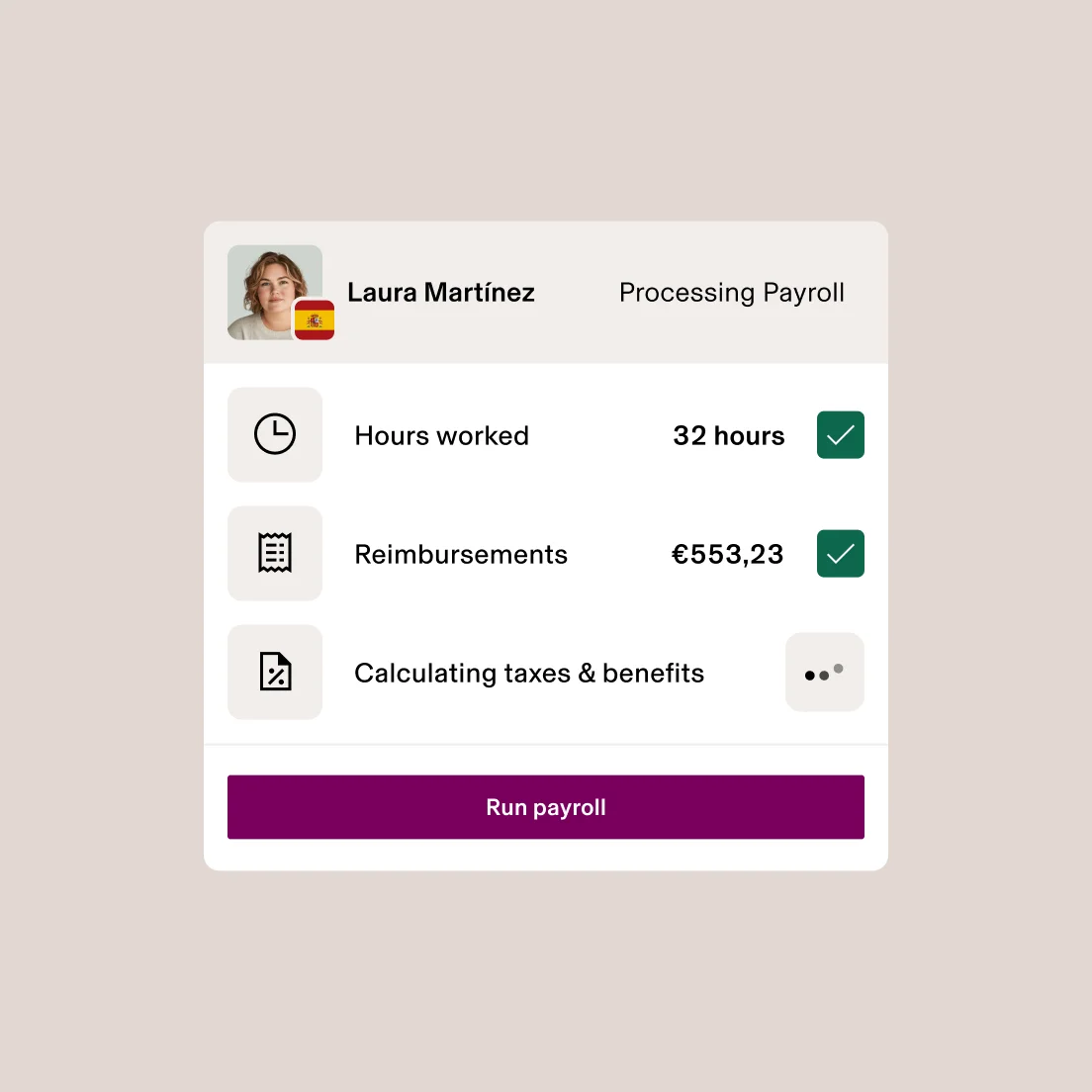
US payroll is native: tax filing, W-2 generation, direct deposit, garnishments, new-hire reporting. In the 7 native-payroll countries, Rippling processes payroll directly rather than through a partner. Rippling claims it automates 95 percent of payroll administration, supports unlimited off-cycle runs for bonuses and corrections without an extra fee, and lets you set custom pay types and multi-level approvals.
Contractor payments cover 185+ countries in 50+ currencies, with misclassification guardrails that flag high-risk classifications before you commit. Rippling retains historical records when you convert a contractor to an employee, and an Employee Cost Calculator estimates the loaded cost of a hire per country before you commit.
Rippling Compliance and IT Management
In the 7 native-payroll markets, Rippling controls compliance end to end. In the other 73, compliance runs through the local partner; Rippling adds a verification layer but the legal employer is the partner.
No other EOR provider matches Rippling’s IT module. MDM covers Apple, Windows, and Android. App provisioning connects to 600+ apps including Slack, GitHub, Google Workspace, and Microsoft 365.
If a departing employee has ever kept AWS console access for three weeks because IT and HR were not coordinating, you understand why this matters.
Rippling Integrations and API Access
Rippling connects to 600+ third-party apps. Accounting: QuickBooks, NetSuite, Xero, and Sage Intacct. Identity: Okta, Azure AD, Google. Collaboration: Slack and Zoom provision on hire and deprovision on exit.
ATS: Greenhouse, Lever, Workday Recruiting. Open API and SCIM connector for enterprise workflows.
What does Rippling actually cost?
Rippling is a workforce management platform that includes EOR rather than an EOR with HR features bolted on, and the pricing reflects exactly that. The mandatory base platform fee, the module-stacking model and the $499 to $1,000-plus EOR range are routinely under-quoted by 30 to 50 percent; here is what to confirm before signing.
| Base platform (required) | From $35per month + $8 / user / month |
|---|---|
| Employer of Record | $499–$1,000per employee / month (quote) |
| Global Payroll add-on | From $200per employee / month |
| US Payroll | From $8per user / month |
| Contractor payments | Quote185 countries, 50 currencies |
What the headline price leaves out
Base platform fee is mandatory on every user. Rippling's $35 plus $8 per user per month base HRIS fee is required before any module activates, including for your purely domestic staff who never touch EOR or international payroll. On a 100-person company that base fee alone is roughly $10,000 a year, charged whether you use one Rippling module or six.
Module stacking, not bundled pricing. EOR, Global Payroll, US Payroll, IT, Finance, Time and Attendance, and Benefits are each priced separately on top of the base platform. The headline EOR range of $499 to $1,000 is the module fee only. Procurement teams routinely under-quote Rippling by 30 to 50 percent the first time they build a comparison spreadsheet.
Annual commitment with non-refundable fees. Quotes are structured as annual commitments with minimum user counts. Mid-term reductions are not refunded; the renewal cap is 5 percent or CPI for stable scope. If your headcount is volatile, the floor is what you pay even if the ceiling never gets used.
The extras that surface later. Third-party reports flag year-end payroll processing for W-2 and 1099 forms, device logistics (warehousing, shipping, and retrieval) for remote staff, and extra US state registrations for multi-state teams as common add-on costs. The first pay run on a new or updated business bank account may need a wire transfer rather than an ACH debit, and you still pay the licence fees for any third-party software (Salesforce, Adobe, and similar) that Rippling only provisions, not supplies.
Before you sign, ask Rippling to confirm in writing:
01. The total monthly cost including base platform fee, every module you will use, and projected headcount.
02. Whether the EOR module fee is fixed per country or varies, and the exact per-country quote.
03. Annual minimum user count, what triggers true-up charges, and what happens on mid-term reductions.
04. FX margin on international payroll disbursement per corridor, and whether the rate is fixed monthly.
05. Renewal price cap mechanics and notice period for non-renewal.
Request Rippling pricing →How does Rippling’s compliance model hold up across key markets?
Rippling’s EOR covers 80+ countries, but the compliance model needs careful reading before legal review.
Rippling does not own legal entities for EOR. All 80+ countries run through third-party in-country partners, the same model as Papaya Global. Remote runs 100% owned entities; Deel uses a mixed model.
The local partner is the legal employer in every EOR engagement. In the 7 native-payroll countries, Rippling controls payroll directly. In the other 73, both employment and payroll flow through partners.
In the UK specifically, the split is worth spelling out. Rippling is an HMRC-recognised payroll provider and runs UK payroll on its own engine, calculating PAYE and filing Real Time Information returns to HMRC directly rather than routing them through an aggregator, which is why the UK sits in that seven-country native group. It calculates and remits tax to HMRC, issues GBP payslips, and updates the engine as tax law and rates change.
On UK contractors, Rippling helps with worker classification and IR35 status. It offers a free Worker Classification Analyzer and points users to HMRC’s CEST (Check Employment Status for Tax) tool, and it advises regular status reviews on long-term engagements where HMRC weighs factors such as the history of the role. Even so, its UK-specific edge-case coverage, IR35 in particular, reads lighter than its core HR and payroll, so keep your own tax advice in the loop.
What native payroll does not change is who employs your UK hire. On a UK EOR engagement the legal employer is still a local partner, not a Rippling-owned entity, so the compliance-chain question your legal team will ask applies to UK headcount just as it does everywhere else. Treat fast, native PAYE as an operational win, not as the owned-entity certainty some of Rippling’s UK marketing implies.
This matters when legal asks who the employer is. Some teams flag the answer as a compliance chain gap. If owned-entity certainty is a hard requirement, Remote is the only major provider that delivers it.
On data and security, Rippling holds SOC 1, SOC 2, ISO 27001, ISO 27018, ISO 42001, and CSA STAR Level 2. For European customers it offers in-region data residency and the standard data-processing agreement under the controller-and-processor split UK and EU employers need for their records.
What is the Rippling platform and support experience like?
Rippling’s user experience is consistently rated among the best in the category. Onboarding automation is the most cited strength: device shipping, app provisioning, payroll setup, permission configuration, and benefits enrolment trigger from the same workflow. Rippling claims a new hire can be set up in as little as 90 seconds. The trade-off is a steeper learning curve when you activate several modules at once, particularly the IT and Spend tools, where the initial configuration takes longer than the marketing implies.
Support is admin-gated and primarily chat-based. Only HR administrators access live support; employees route through HR. Phone support is generally reserved for larger accounts, and lighter queries lean on chatbots and self-serve articles, which makes live help less accessible in a time-critical moment. For a 15-person startup where the founder is both HR and IT admin, that is one more queue during stressful onboarding.
Rippling claims a 51-second median response (self-reported). G2 reviews are positive on speed but mixed on resolution for complex compliance issues in partner countries; older reports of slow replies on pricing disputes appear to have eased in 2025 to 2026 feedback.
The Deel litigation factor. In 2025, Rippling filed RICO and trade-secret claims against Deel alleging corporate espionage. A federal judge allowed the claims to proceed and the DOJ opened a criminal probe.
The case is live as of May 2026. Include it in vendor risk assessment; ask both vendors for statements before deciding.

What are Rippling customers actually saying?
Rippling earns the highest user satisfaction scores of any provider we cover.
G2: 4.8/5 (5,000+ reviews). Capterra: 4.9/5 (3,000+ reviews).
Praise: single-trigger automation on hire and offboard; unified HR, IT, and finance dashboard; US payroll accuracy; integration breadth; self-service employee experience.
Complaints: pricing opacity; non-US features lagging US ones; mixed support on complex EOR edge cases; minimum user counts; heavy HRIS migration from Workday or ADP.
Platform buyers rate Rippling highly. Buyers who adopted it primarily for EOR, and found the base platform heavier than expected, give lower scores.
What are Rippling’s genuine strengths and limitations?
Pros
- Only platform unifying HR, IT, and Finance in one employee record
- Highest G2/Capterra ratings at scale in the EOR category
- Native payroll engines in 7 countries (US, CA, UK, IE, FR, AU, IN)
- IT management (MDM, app provisioning, SSO) built into the platform
- 600+ third-party integrations including accounting, identity, and ATS
- Contractor payments in 185+ countries with misclassification guardrails
- Modular architecture. Add products as you grow without switching platforms.
- Single employee record eliminates reconciliation between HR, IT, and Finance
Cons
- EOR cannot be purchased standalone. Base HRIS required for all employees.
- No owned legal entities. All EOR through third-party partners.
- 80-country EOR coverage is narrower than Deel (150+) or Papaya Global (160+)
- EOR pricing not published. Sales engagement required for a quote.
- Annual contracts with minimum user counts. No mid-term headcount reduction.
- US-centric architecture. Non-US features consistently lag behind US features.
- Support admin-gated. Employees cannot contact Rippling directly.
- Platform lock-in increases with each module adopted. Switching costs are high.
Who Is Rippling Best For?
Rippling works as a platform decision, not an EOR-only decision. The strongest fit, and the fastest adoption we see, sits in the 100 to 2,000 employee range; it scales up to customers with more than 10,000 staff, but it is overkill for micro teams of fewer than ten.
US-HQ teams unifying domestic and international. US payroll, benefits, EOR in 80+ countries, and contractors in 185+ flow through one record. Consolidation closes reconciliation gaps between US payroll, EOR, and IT.
IT-led platform decisions. MDM, app provisioning, SSO, and inventory live inside HR and payroll. Onboard someone and the laptop ships and apps provision from one workflow.
Series A-C startups consolidating vendors early. Start with HRIS and US payroll, add EOR, IT, and finance later. Early adoption saves future migrations if the fit is right.
Choose Rippling
- You are a US-HQ team unifying domestic payroll and international EOR
- The decision is IT-led: MDM, app provisioning, and SSO inside HR and payroll
- You are a Series A-C startup consolidating vendors early
- You want a single employee record across HR, IT, and finance
Look elsewhere if
- You only need EOR without an HRIS migration
- Legal requires owned-entity employer-of-record
- You are not US-headquartered
- You need EOR in more than 80 countries
- You have simple HR needs or a tight budget and value lower cost over automation
- You are a small team under 50 to 100 staff prioritising simplicity
- You are in a highly regulated industry that needs specialist compliance tools
When should you consider a Rippling alternative?
For a fuller comparison, see Rippling alternatives.
Book a Rippling demo →Final Verdict: Is Rippling Worth It?
Rippling is worth it when the problem is vendor fragmentation across HR, IT, and Finance and you will commit to one platform. Lifecycle automation and cross-system triggers solve real operational problems, and review scores at volume confirm platform buyers are satisfied.
It is not worth it when EOR is the only product you need, legal requires owned-entity certainty, you are not US-headquartered, or the forced HRIS migration creates more disruption than the EOR value justifies.
The question to ask before engaging sales: are we buying a platform or an EOR? Platform, Rippling wins. EOR, Deel or Remote will serve you better.
Book a Rippling demo →Rippling FAQ
Can you buy Rippling EOR without the base HRIS?
No. The base HRIS (Rippling Unity at $35/month plus $8/user/month) is mandatory for all modules, including EOR.
Every employee, domestic and international, sits on the base platform. That is the single biggest structural difference versus Deel or Remote.
What does Rippling EOR cost?
Rippling does not publish EOR pricing. Third-party reports place it at $499-$1,000/employee/month depending on country and volume, on top of the $8/user/month base fee.
Statutory employer costs, FX, and module add-ons are extra. You must engage sales for a quote.
Does Rippling own its EOR entities?
No. All 80+ EOR countries run through third-party in-country partners. Rippling has native payroll engines in 7 countries (US, Canada, UK, Ireland, France, Australia, India), but the legal employment relationship in every EOR country sits with the partner, not Rippling.
Methodology and Disclosure
Whichapp is an independent comparison site for global payroll, EOR, and contractor management platforms. We do not sell these services and do not accept payment for editorial placement or reviews. We may earn a commission if you book a demo or request a quote through links on this page.
This review was produced by our editorial team and was not reviewed or approved by Rippling before publication.
Data Sources
Rippling product pages and feature documentation (verified June 2026) · G2 and Capterra reviews (Jan–Apr 2026) · Rippling help centre and onboarding guides · Rippling pricing confirmed via sales process (no published rate).
Research Approach
Assessed across platform modularity and workforce management breadth, EOR coverage and entity model, domestic payroll capabilities, integration depth, customer support model and implementation scope, and verified user feedback from G2 and Capterra. Pricing was assessed through sales engagement; no published rate is available. Live paid pilot was not conducted.
Tools to Evaluate Rippling
Provider Coverage Lookup: check which countries each provider covers and compare coverage side by side. EOR vs Entity Break-Even Modeler: find the headcount at which setting up your own entity beats paying EOR fees. Employer Cost & Burden Calculator: turn a gross salary into a realistic total employer cost by country.
Whichapp Research used in this review
Pricing Transparency Index: how clearly this provider discloses pricing compared to the market. EOR Cost Benchmark: published EOR fee range and first-year cost context across 17 providers. Global Payroll Coverage Index: country breadth and owned-entity depth scored across providers. Integration Depth Index: HR and finance integration coverage scored by provider. Security Disclosure Benchmark: SOC 2, ISO 27001, and public security disclosure ratings.