Safeguard Global Review
Last reviewed: June 2026 · Based on safeguardglobal.com, G2/Trustpilot review data (2024-2026), NelsonHall 2025 NEAT evaluation, and competitive provider research
Safeguard Global has been in the global employment business since 2008. That is 17 years of compliance infrastructure across 170-187 countries, managed payroll through Global Pay, and white-glove service via a network of 400-plus in-house local experts spread across more than 70 countries.
NelsonHall named it a Leader in its 2025 Global EOR Services evaluation. That is a useful signal, but NelsonHall is an analyst firm, not a compliance auditor. The Leader designation reflects service capability, not entity verification in your hiring markets.
Only ~30 of those 187 countries are served through its own entities. The remaining 82% runs through local partners. That is the weakest own-entity ratio among any major EOR provider we track.
A 2.9/5 Trustpilot rating set against 4.2/5 on G2 tells you the gap between procurement experience and employee experience is not small.
In March 2025, Safeguard Global sold its enterprise payroll division to Deel and pivoted toward SMBs and mid-market. The provider you are evaluating today is not the same company that built its enterprise reputation.
Our verdict
Safeguard Global works best when you want a provider that operates more like an outsourced compliance department than software.
Managed payroll and local HR support are genuine differentiators. The partner-heavy entity model and pricing opacity are harder to defend in 2026, where transparent own-entity coverage is table stakes.
Best for: legacy managed payroll services.
Safeguard Global quotes EOR per engagement, not from a rate card. Safeguard Global does not publish an EOR headline. The variables that shape your quote — employer taxes, deposit, setup and terms, FX and currency, entity model, and support tier — only the provider can confirm. Ask for an all-in monthly figure before you compare.
How Safeguard Global scores on the Whichapp Index
| Coverage model | Aggregator 187+ countries claimed, only ~30 owned entities |
|---|---|
| Pricing transparency | Low Quote-based only |
| Integration depth | Low |
| Security & compliance | Moderate |
Composite is a weighted index across these verified dimensions — see methodology.
Safeguard Global key facts
| EOR coverage | 170-187 countries Only ~30 owned entities |
|---|---|
| EOR pricing | $499-650/month (estimated) No public pricing |
| Contractor pricing | $5-10/month Cheapest published rate |
| G2 rating | 4.2/5 HR buyer satisfaction |
| Trustpilot rating | 2.9/5 End-user experience |
| Founded | 2008 17 years in market |
Source: safeguardglobal.com, G2, Trustpilot, third-party analyses, verified June 2026
What Is Safeguard Global and How Does It Work?
Safeguard Global operates across four product lines: Employer of Record, Global Pay (managed payroll), contractor management, and entity setup support. The company differentiates through human-led compliance, not self-service automation.
What Safeguard Global Does
It provides legal employment through owned entities in ~30 countries and vetted partners in 140-157 additional markets. Each employee gets a dedicated local HR representative in their country and time zone.
Global Pay consolidates payroll across 150+ countries with unified reporting. Contractor management covers 187 countries at $5-10/month with 60-second onboarding, but lacks the misclassification risk scoring Deel or Remote offer.
How Safeguard Global Setup Works
EOR onboarding runs 3-7 business days, unless you are hiring in Brazil or Germany where 2-4 weeks is more realistic. Partner-served countries add coordination delays. The reason Safeguard runs slower than the 2-3 day onboarding Deel or Remote advertise in some markets is deliberate: it keeps manual compliance steps in the loop, such as contract customisation, local benefits verification and regulatory pre-checks, that faster rivals have largely automated. If you are going the entity-setup route instead of EOR, budget longer again, typically around 30 to 45 days to stand up an entity plus a further four to six weeks for tax registration.
Contractor onboarding completes in 60 seconds with documentation ready. Global Pay implementation runs weeks rather than months and requires custom configuration sessions. There is no self-service setup.
What Are Safeguard Global’s Products and Features?
Product breadth spans employment, payroll, and contractor management. Depth varies dramatically.
Global Pay represents genuine technical capability. The EOR service relies on relationships rather than owned infrastructure.
Employer of Record covers 170-187 countries with only ~30 owned entities. In the remaining 140-157, your employees’ legal employer is whatever local partner Safeguard Global has contracted with.
Global Pay processes payroll across 150+ countries through one platform. Unified calendars and pre-configured workflows solve a real problem for companies with existing entities in 15+ countries.
For enterprise buyers already standardised on Workday, the more specific draw is Payroll 360, Safeguard Global’s managed-payroll tier that runs payroll in-country and feeds the results back into your own HRIS rather than asking your team to live in a separate tool. Its Workday Global Payroll Connect integration moves data both ways in close to real time across a set of certified API connectors, so pay results land in Workday without the spreadsheet hand-offs that usually sit between a global payroll vendor and an HCM system. Safeguard describes Payroll 360 as integrating with all leading HCMs and bills itself as Workday’s only global payroll partner, so if you are not on Workday this matters less, but if you are, it is one of the cleaner integrations in this market.
Contractor management handles 187 countries at the lowest published price. The platform offers basic payment rails without compliance tooling.
No automated tax form collection. No misclassification scoring.
Intelligent Workforce is Safeguard’s planning layer, an AI-driven tool that lets you compare hiring scenarios across 187 countries and model total cost of hire, including salary ranges, employer costs and market conditions, off its own live employment data and 400-plus in-country experts rather than static benchmarks. It is a useful pre-decision tool for finance teams weighing where to build a team, and it folds in the compliance-risk and headcount signals enterprise buyers used to reach through the older GIA reporting. Recruitment can be bolted onto EOR too: Safeguard’s in-house, multilingual talent experts source and place candidates in-market, so you can run hire-to-payroll through one vendor rather than stitching an agency to an EOR.
Safeguard Global Platform Experience
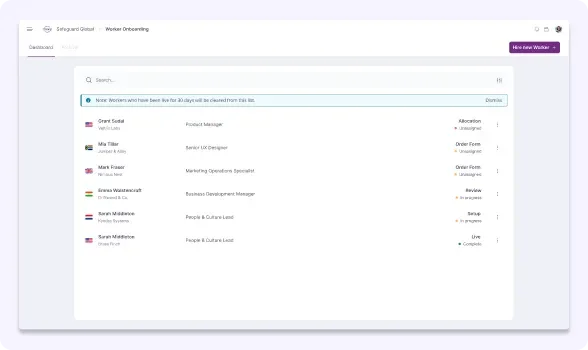
The platform reflects multiple acquisitions stitched together. Legacy names (GEO, MIHI, Global Unity, Contractor Unity) suggest different systems talking to each other rather than one cohesive product. The day-to-day workforce admin is here, including time tracking and expense management, but it spans those legacy modules rather than living in one clean workflow.
Integrations and API access lag the market. GDPR constraints limit third-party HRIS connections.
Where Deel offers 120+ integrations, Safeguard Global offers workarounds. The UX works but does not delight.
How Much Does Safeguard Global Cost?
Safeguard Global lists a $499 EOR starting rate but third-party data and G2 figures put the realistic range at $499 to $699 depending on country mix and headcount. The partner-entity coverage in non-major markets and the FX line are the items most often skipped; here is what to confirm before signing.
| Employer of Record | From $499per employee / month (typical $499–$699) |
|---|---|
| Contractor management (1–10) | $10per contractor / month |
| Contractor management (11+) | $5per contractor / month |
| Custom enterprise quote | Quotenegotiated by sales |
What the headline price leaves out
Published rate is a floor; real quotes land higher. The $499 starting rate appears on marketing pages and the cost calculator, but third-party reviewers and G2’s pricing data put the realistic range at $499 to $699, with custom enterprise quotes pushed through sales rather than priced openly. Treat $499 as the floor and budget for the midpoint. Safeguard’s own pricing explainer describes a fixed per-employee model ranging up to $1,200 a month, so enterprise headcounts can sit well above the $499 marketing figure. Third-party analyses estimate total EOR cost, including salary, taxes and benefits, at roughly $7,000 to $18,000 per employee a year for mid-market hires, which can run materially higher than a transparent-rate competitor like Deel for the same small headcount.
Managed payroll and contractor lines are priced separately. Global Pay managed payroll is quoted per employee per month on top of any EOR fee, and reviewers put it in the low tens of dollars per employee. Watch for the add-on charges Safeguard does not surface on the rate card: off-cycle payroll runs, termination processing, local benefit enrolment administration, and annual salary-review adjustments. Each is normal in this market, but each needs to be in the quote before you compare.
Partner-entity coverage in some markets. Safeguard runs owned entities in major markets but uses local partners in others. Partner-served countries introduce a markup on services, slower compliance turnaround, and an extra contractual layer between you and the legal employer. Confirm whether your target country is direct or partner-served before signing.
Employer taxes and FX sit outside the seat fee. The advertised rate is the platform fee only; gross salary, employer statutory contributions (10 to 35 percent depending on country) and FX conversion margin all pass through on top. Safeguard does not publish its FX spread; enterprise EOR norms put it at 1 to 2 percent over mid-market.
Before you sign, ask Safeguard Global to confirm in writing:
01. The actual per-seat monthly cost for your specific target country, not the $499 marketing rate.
02. Whether Safeguard is the direct legal employer in each target country or a local partner is.
03. The FX margin applied to your funding-to-local-currency conversion, per corridor.
04. Employer-tax pass-through rate per country and how it appears on the monthly invoice.
05. Minimum contract length, notice period, and severance pass-through exposure.
06. The current security attestations (Safeguard publishes SOC 1 and GDPR alignment; ask whether SOC 2 Type II and ISO 27001 are in scope) and where employee data is held for any transfers outside the EEA.
Request Safeguard Global pricing →Whichapp may earn a commission if you book a demo through our links. Reviews remain editorially independent.
What Is Safeguard Global’s Country Coverage and Compliance Model?
Safeguard Global claims 170-187 countries. Only ~30 use its own legal entities. This 18% own-entity ratio is the weakest among major providers.
Remote runs 100% owned. Atlas claims the same. Deel manages ~50% owned coverage.
Safeguard Global’s Entity Model
In owned-entity countries, Safeguard Global is the direct legal employer. In partner countries, a local third-party becomes the legal employer. Vetting is not control.
The company does not publish which countries use which model. During procurement, request this list for your target markets.
Safeguard Global Coverage for Specific Use Cases
High-volume markets like the US, UK, and Germany likely use owned entities, though Safeguard Global does not confirm publicly. Emerging markets almost certainly use partners.
Complex regulatory environments like Brazil or India benefit from local HR expertise, but confirm whether that expertise comes through an owned entity or partner. Rapid expansion plans hit the partner model hardest.
How Do Users Rate Safeguard Global’s Experience and Support?
The user experience splits into two different realities. Managed-service support delivers human expertise. Platform experience feels like it missed the last decade of UX evolution.
Safeguard Global Onboarding and Platform
EOR onboarding runs 3-7 business days for straightforward cases. Brazil and Germany stretch to 2-4 weeks. The process is human-led with implementation specialists.
Navigation between modules requires mental mapping. Data does not always flow cleanly between systems built from different acquisitions.
Safeguard Global Customer Support
The dedicated local HR representative model is the standout feature. You get a person who knows your account in your own time zone, not a ticketing system. The trade-off cuts both ways: because support is anchored to the employee’s local hours rather than a round-the-clock desk, US-based admins occasionally wait for a partner-country contact to come online, so build that into your escalation expectations rather than assuming 24/7 cover.
G2 (HR buyers) rates support at 4.2/5 and post-sales support lands around 4.0, while Trustpilot (employees) rates it 2.9/5. The most consistent buyer-side complaints are account-manager turnover and patchy transparency on payroll invoicing, so ask how account continuity is handled and how invoices break down line by line.
Employees report expense reimbursements taking two months, tax errors that persist across pay cycles, and offboarding communication that leaves people wondering about final payments.
What Do Safeguard Global Customers Say?
Customer reviews tell two different stories. HR buyers on G2 praise the human element. Global Pay users appreciate the consolidation: 15 local providers into one platform.
Trustpilot reviews from employees read like a different company. Tax withholdings calculated incorrectly then taking months to fix.
Expense reimbursements submitted in January and paid in March. Platform fragmentation frustrates users expecting modern UX.
What Are Safeguard Global’s Pros and Cons?
Pros
- Managed global payroll at scale. Global Pay handles 150+ countries with unified reporting. For companies with existing entities, this solves a coordination nightmare.
- Genuine local expertise. 400+ in-house experts understand local labour law, cultural nuances, and regulatory changes. Your Brazilian labour law question gets answered by someone who actually understands Brazilian labour law.
- Breadth of coverage. 170-187 countries gives you expansion options even with the partner-heavy model.
- Contractor pricing that competes. $5-10/month for 187 countries beats everyone for basic payment rails.
- EOR-to-entity continuity. When you outgrow EOR, Safeguard Global connects you with entity setup partners and transitions your payroll without switching vendors.
Cons
- Weakest own-entity coverage in the market. 18% owned entities means 82% of countries use partners. Your legal team will flag this as the primary risk.
- Employee experience that damages employer brand. The 2.9/5 Trustpilot rating is not an outlier. Tax errors, expense delays, and poor communication are consistent themes.
- Platform fragmentation that shows its age. Multiple legacy systems create training burden and workflow friction. Deel feels like one platform. Safeguard Global feels like four platforms in a trench coat.
- Pricing opacity that complicates procurement. No published EOR rates means every evaluation requires sales cycles.
- Strategic uncertainty post-acquisition. Selling the enterprise payroll division to Deel and pivoting to SMB changes the company’s focus. Enterprise clients are no longer the target.
Who Is Safeguard Global Best For?
Companies with existing entities needing managed payroll in 10+ countries benefit most from Global Pay’s consolidation. Highly regulated industries need compliance documentation that goes beyond platform automation.
Phased global expansion teams get continuity: start with EOR, transition to owned entities, keep the same vendor. Contractor management at scale wins on $5-10/month price. Relationship-based buyers get the phone-call model over self-service. On EOR specifically, Safeguard tends to fit organisations hiring at scale, roughly 25 to 50-plus international employees, rather than a first one or two hires, and it is strongest in regulated, high-complexity sectors such as life sciences, financial services and technology where the in-country compliance expertise earns its keep.
Choose Safeguard Global if
- You have existing entities needing managed payroll in 10+ countries
- You operate in a highly regulated industry needing compliance documentation beyond platform automation
- You are running phased global expansion and want EOR-to-entity continuity with one vendor
- You need contractor management at scale on a $5-10/month price
- You are a relationship-based buyer who prefers the phone-call model over self-service
Look elsewhere if
- Own-entity control drives your decision
- Platform experience drives your decision
- Pricing transparency drives your decision
- Employee satisfaction drives your decision
What Are the Best Safeguard Global Alternatives?
Each alternative addresses specific weaknesses. Your choice depends on which limitation creates the most operational risk for your situation.
Top alternatives to put side by side with Safeguard Global: Deel, G-P, and Velocity Global.
See our Safeguard Global alternatives guide and best EOR providers ranking.
Book a Safeguard Global demo →Whichapp may earn a commission if you book a demo through our links. Reviews remain editorially independent.
Is Safeguard Global Worth It in 2026?
Worth it for a specific buyer: companies that need managed services more than modern platforms, global payroll alongside EOR, and human expertise over self-service. The 17-year track record is real. The 400+ local experts provide genuine value.
But the platform is not competitive in 2026. The 18% own-entity ratio is the weakest in the market. Employee experience issues will affect employer brand.
Do not choose it if own-entity compliance control is non-negotiable, employee platform experience affects retention, or transparent pricing is required.
Best fit for: enterprise payroll teams hiring in high-complexity regulatory markets and frontier regions most EORs avoid. Main reason to book: managed payroll service scope and pricing vary significantly by market, so confirm your specific country list and service tier upfront. Main reason to compare: for standard markets at sub-enterprise headcounts, Deel or Remote deliver comparable coverage at a lower cost and faster onboarding.
Book a Safeguard Global demo →Whichapp may earn a commission if you book a demo through our links. Reviews remain editorially independent.
Safeguard Global FAQ
How much does Safeguard Global EOR cost?
EOR starts from $499/employee/month per third-party sources, with competitor estimates at ~$650. No public pricing exists.
Every quote requires a sales call. Additional costs include employer taxes (20-45% of gross), undisclosed FX margins, and partner markups in non-owned-entity countries.
Does Safeguard Global use owned entities or partners?
Safeguard Global owns entities in ~30 countries out of 187 claimed. The remaining 140-157 use local partners. This 18% own-entity ratio is the weakest among major providers.
Remote and Atlas operate 100% owned entities. G-P maintains 95%. Demand a written list showing entity ownership by country during procurement.
What are the main risks with Safeguard Global?
The 18% own-entity coverage creates compliance uncertainty. Employee experience issues (2.9/5 Trustpilot) damage employer brand through tax errors and expense delays.
Platform fragmentation from acquisitions increases training burden. The 2025 pivot to SMB suggests existing large clients are no longer priority.
How does Safeguard Global handle UK payroll and IR35?
For UK EOR employees it runs PAYE, operates income-tax and National Insurance deductions, and handles statutory contributions, with pension auto-enrolment expected as part of compliant UK payroll. Because the worker is employed through the EOR, an inside-IR35 engagement is processed through PAYE in the normal way.
As the legal employer in owned-entity UK hires, Safeguard typically takes on IR35 status determination, but in any partner-served arrangement confirm in writing who issues the status determination statement and who carries the liability before you sign.
Methodology and Disclosure
Whichapp is an independent comparison site for global payroll, EOR, and contractor management platforms. We do not sell these services and do not accept payment for editorial placement or reviews. We may earn a commission if you book a demo or request a quote through links on this page.
This review was produced by our editorial team and was not reviewed or approved by Safeguard Global before publication.
Data Sources
Safeguard Global services and documentation (verified June 2026) · G2 and Capterra reviews (Jan–Apr 2026) · Safeguard Global country guides and managed payroll documentation · Pricing confirmed via sales engagement (no published rate).
Research Approach
Assessed across managed payroll capabilities in high-complexity markets, country coverage and frontier-market depth, service model and account management, pricing model (confirmed via sales), compliance infrastructure, and verified user feedback from G2 and Capterra. Live paid pilot was not conducted.
Tools to Evaluate Safeguard Global
Employer Cost & Burden Calculator: turn a gross salary into a realistic total employer cost by country. Payroll Deadline Tracker: check payroll filing requirements and deadlines by country. Provider Coverage Lookup: check which countries each provider covers and compare coverage side by side.
Whichapp Research used in this review
Pricing Transparency Index: how clearly this provider discloses pricing compared to the market. EOR Cost Benchmark: published EOR fee range and first-year cost context across 17 providers. Global Payroll Coverage Index: country breadth and owned-entity depth scored across providers. Integration Depth Index: HR and finance integration coverage scored by provider. Security Disclosure Benchmark: SOC 2, ISO 27001, and public security disclosure ratings.