
Remote.com vs Rippling
Remote and Rippling represent two different bets on international hiring. Remote built an EOR specialist that is owned-entity-first, owning entities in around 90 core markets and reaching 180+ through vetted partners. Rippling built a unified workforce platform for US companies and bolted on EOR (80 countries) through a mix of owned and partner entities.
The head-to-head
Choose Remote for entity transparency, no deposit, and a clean EOR-first model; choose Rippling to unify HR, IT, and payroll across both US domestic and international hiring.
| Compared |
 Remote Remote |
 Rippling Rippling |
|---|---|---|
| Score (Whichapp composite, /10) | 8.0 | 6.4 |
| Price | $599From $599/mo | Quote-based |
| Deposit | None | Varies |
| Countries | 90+ owned (180+ reach) | 80 (EOR) |
| Entity model | Owned-entity-first (~90), partners beyond | Owned + partner |
| Best for | Entity transparency, no deposit, IP Guard | Unified HR + IT + payroll in one platform |
| Watch out for | Fewer country markets than Deel | US-centric; EOR country reach is narrower |
The verdict: Remote.com vs Rippling
Remote wins on
EOR depth: an owned-entity-first model (~90 owned markets), flat published pricing and IP Guard for R&D hires.
Rippling wins on
Platform breadth: 600+ integrations and unified HR, IT and Finance for US-anchored teams.
Price from
Remote
EOR $599/mo per employee on annual plan ($699 month-to-month), contractor management $29/mo, no setup or platform fees, no per-module stacking.
Rippling
EOR $499-1,000/mo per employee (custom quote), HR from $8/mo + $35 base fee with payroll, IT and Finance modules layered on top, implementation $1,500-20,000.
Best for
Remote
Distributed-first teams where international employment IS the problem, hiring across 15-25+ countries and needing audit-trail IP transfer for R&D hires in emerging markets.
Rippling
US-anchored Series B+ teams consolidating HR, IT and Finance into one Workforce Graph, with international headcount as a 20% bolt-on rather than the core.
Deal breaker
Remote
No IT or Finance products at all (Okta, Jamf and expense tooling still required), and the no-refund policy on early EOR terminations means monthly fees are not prorated.
Rippling
Around 80 EOR countries with partner-entity reliance in many growth markets, modular per-module pricing that is hard to forecast annually, and implementation fees up to $20,000.
How evaluated: Live pricing pages on both vendors + Whichapp 2026-03 comparison dossier + G2 ratings (Remote ~4.3 on EOR scope, Rippling ~4.6 on broader product scope, verified March 2026). Last checked: 2026-03-31. Whichapp evaluates comparison pages quarterly. No paid placement.
Key differences at a glance
Pricing. Remote wins on predictability with $599/employee/month applied everywhere. Rippling pricing sits in a $499-1,000 range that depends on country, volume, and contract length, plus $8/employee plus $35 base in platform fees.
Compliance. Remote owns every entity, so you have one contractual counterparty globally. Rippling owns entities in primary markets (UK, Germany, France) and uses third-party partners in secondary markets, which can mean different response times and severance practices by country.
Country coverage. Remote spans 180+ countries through owned entities, including edge markets like Kazakhstan, Uruguay, and Malta. Rippling covers around 80 countries focused on where venture-backed tech companies typically hire.
Support. Neither provider excels.
Remote users report 2-5 business day replies on complex termination questions. Rippling provides live chat with queue indicators but no phone support, and EOR-only clients sit on basic tiers unless they negotiate upfront.
Platform consolidation. Rippling replaces HRIS, payroll, benefits, time, expense, device management, and identity in one tool. Remote does international employment and nothing else.
Remote.com vs Rippling at a Glance
The head-to-head card above sets the frame. Remote.com is an EOR specialist that owns 100% of its entities in every country where it sells, and prices employment at a flat published rate.
Rippling is a unified workforce platform that grew out of US HR, IT and Finance, then added EOR as a module on top of that data graph. The two meet on international hiring, but they arrive from opposite ends.
Remote.com publishes EOR pricing from $599 per employee per month and reaches 180+ countries through owned entities. Rippling quotes EOR per employee on request, covers around 80 countries through a mix of owned and partner entities, and concentrates its strength in connected HR, IT and Finance.
The short version: pick Remote.com for entity transparency, IP Guard and predictable pricing; pick Rippling to run HR, IT and payroll as one system. The rest of this comparison stress-tests that summary against pricing, compliance, coverage and support.
Full Comparison Table: Remote.com vs Rippling
The head-to-head card near the top of this page lays out price, deposit, country count, entity model and best-fit use case side by side. Read it as the evidence base for everything below.
Two lines do most of the work. Remote.com leads on EOR depth (owned entities in ~90 core markets, 180+ countries reached, flat $599 pricing); Rippling leads on platform breadth (600+ integrations and unified HR, IT and Finance for US-anchored teams).
Everything else in this article explains what those differences mean for a buyer signing a 12-month contract.
What Are the Key Differences Between Remote.com and Rippling?
The two platforms diverge most sharply on five operational dimensions. Your priority ranking among them effectively makes the decision.
Best for Pricing
Remote.com charges a flat $599/employee/month on the annual plan, $699 month-to-month, applied everywhere with no platform or implementation fees. That predictability makes CFO modelling straightforward.
Rippling quotes EOR at $499-1,000/employee/month plus $8/employee and a $35 base fee, with implementation from $1,500 to $20,000. The modular stacking is harder to forecast across a fixed annual budget.
Best for Compliance
Remote.com owns every entity, so you have one contractual counterparty globally and consistent termination handling. The trade-off is that it sells no IT or Finance products, so Okta, Jamf and expense tooling stay on your plate.
Rippling owns entities in primary markets and uses partners in growth markets, which means service variability country to country. Its compensating strength is automated worker-classification checks built into the platform.
Best for Country Coverage
Remote.com wins coverage outright: 180+ countries through owned entities, including edge markets like Kazakhstan, Uruguay and Malta. Every country runs the same operational model.
Rippling covers around 80 countries focused on where venture-backed tech companies hire, with partner reliance in many growth markets. The narrower reach is the trade for its operational depth elsewhere.
Best for Support
Remote.com assigns dedicated account managers above 25 employees and pools support below that, with complex answers running 2-5 business days. Rippling tiers support by spend, so EOR-only clients can sit on basic tiers unless they negotiate upfront.
Neither model is universally better. The right one depends on headcount and how much you are willing to negotiate at signing.
Best for Unified Operations
This is Rippling's home turf. It replaces HRIS, payroll, benefits, time, expense, device management and identity in one tool, with 600+ integrations wiring into most existing stacks.
Remote.com does international employment and nothing else, with only around 50 integrations. If consolidation is the goal, Rippling is the structurally stronger fit and Remote.com falls short.
What Is Remote.com and What Does It Offer?
Remote is a global employment platform built for international-first companies. It owns and operates legal entities in every country where it sells EOR services.
The platform handles employment contracts, payroll, tax withholding, benefits, and compliance in 180+ countries. Contractors can be paid in 170+ countries for $29/month each.
IP Guard adds a two-stage IP transfer with an audit trail. That matters when hiring engineers in jurisdictions with strong employee IP protections.
Strengths. Owned entities everywhere mean one contract counterparty and consistent terminations. Flat-rate Remote pricing at $599/employee/month makes CFO modelling straightforward.
Limitations. No IT device management, no advanced performance reviews, only ~50 integrations. Support quality has degraded as Remote scaled; complex compliance answers can take 5+ business days.
What Is Rippling and What Does It Offer?
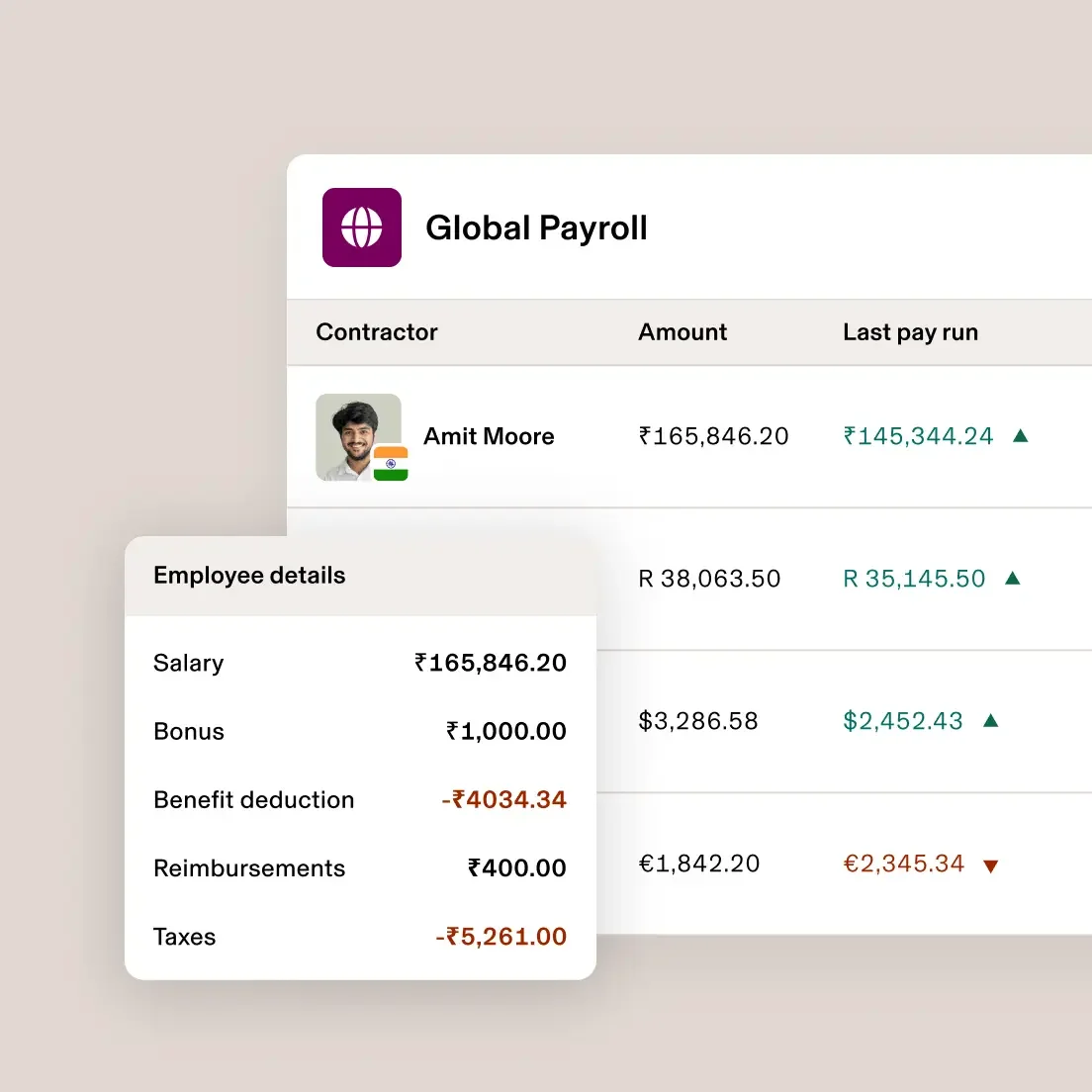
Rippling is a compound startup: multiple products (HR, IT, Finance) unified by employee data. It started serving US businesses and added international as customers expanded.
The platform covers hiring, onboarding, payroll, benefits, time tracking, expenses, device provisioning, and app access control. EOR services cover about 80 countries through a mix of owned and partner entities.
Hire someone and Rippling auto-provisions their laptop, creates accounts in 50+ apps, adds them to payroll, and triggers background checks from one action.
Strengths. Platform unification removes data syncing between HRIS, payroll, IT, and expense tools.
600+ integrations connect to most existing stacks. Security certifications (SOC 1/2/3, ISO 27001, ISO 42001) pass more enterprise procurement gates than Remote’s SOC 2 alone.
Limitations. EOR pricing requires sales negotiation.
The hybrid entity model creates service variability between owned and partner countries. Implementation costs $1,500-$20,000.
How Do Remote.com and Rippling Compare on Features: EOR Depth vs Platform Breadth?
Feature parity is not the question here. The question is whether you want international employment depth or a unified operations platform, because each provider is built around one of those answers.
Employer of Record Services
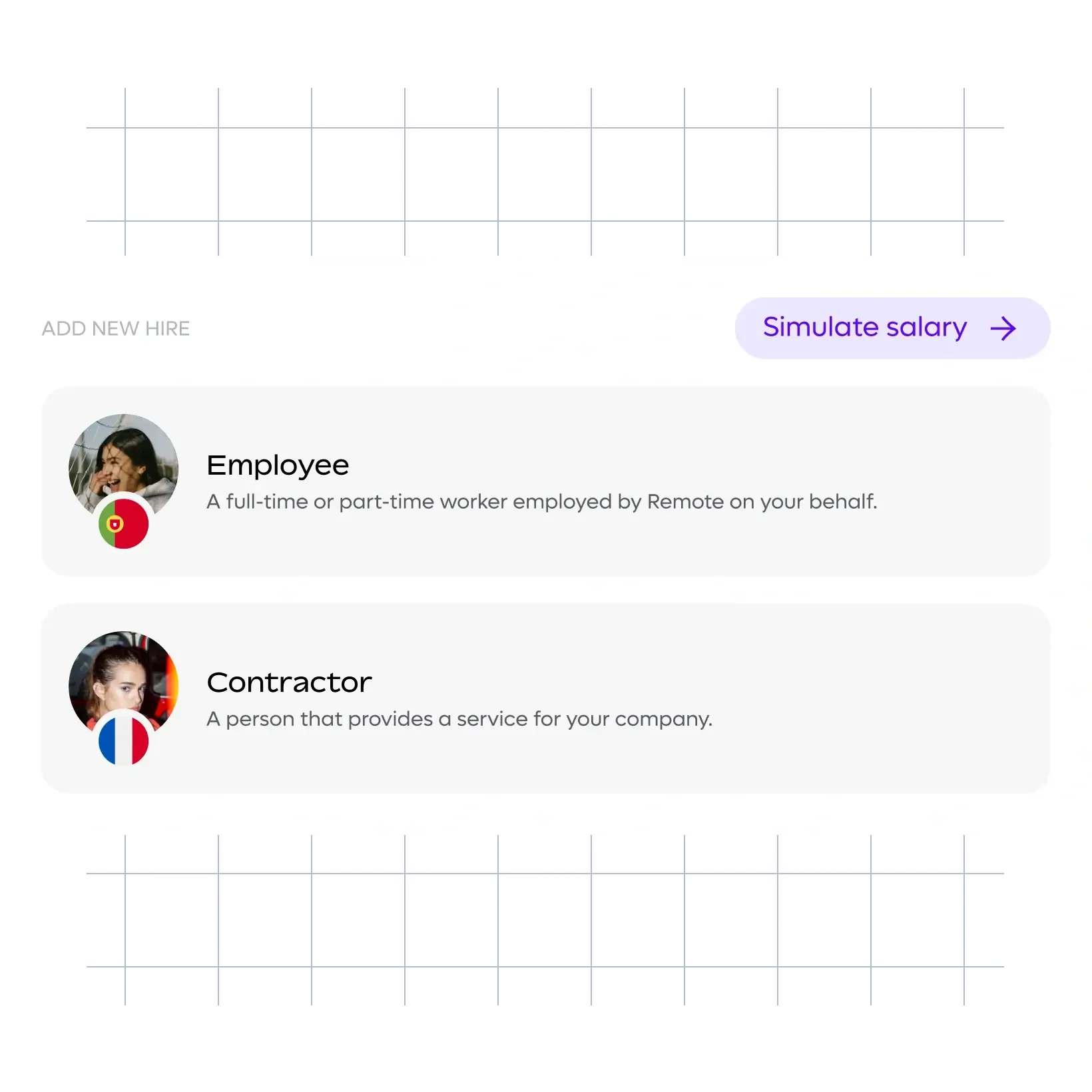
Remote.com's EOR is its founding product: owned entities in ~90 core markets reaching 180+ countries, owned-entity-first, and a flat published price. Rippling's EOR is capable but newer, covering around 80 countries with a quote-only price and partner reliance in growth markets.
For pure EOR across many countries, Remote.com is the deeper tool. For EOR that plugs into an existing Rippling HR system, Rippling wins on integration.
Contractor Management
Remote.com charges $29/month flat per contractor regardless of payment size or country. Rippling bundles contractors into custom quotes, with user reports showing $25-75/month depending on volume.
Predictable per-head contractor cost favours Remote.com. Rippling's pricing only becomes clear once you have a quote.
HR, IT and Integrations
Rippling is the clear leader here: native HRIS, built-in device management and identity, and 600+ integrations. Remote.com offers no IT or device management and only around 50 integrations, so it depends on external tools.
If the HR and IT stack is the priority, Rippling is structurally ahead. Remote.com falls short on native breadth.
IP Protection
Remote.com's IP Guard adds a two-stage IP transfer with a timestamped audit trail, tested in German and UK courts. Rippling uses standard IP assignment clauses, which are thinner for R&D-led companies.
For patent-heavy hiring, Remote.com leads. For most general hiring, the gap matters less.
How Do Remote.com and Rippling Compare on Pricing: Flat Published Rate vs Quote-Plus-Modules?
Headline EOR rates do not tell the full story. Total cost of ownership matters more.
Remote charges $599/employee/month annually or $699 month-to-month, flat globally. The price includes employment, payroll, benefits, and compliance. No platform fees, no implementation charges.
Rippling’s EOR pricing requires sales negotiation. Published ranges sit at $499-1,000/employee/month depending on country risk tier, volume, and contract length. Add $8/employee plus $35 base monthly in platform fees, plus implementation between $1,500 and $20,000.
Total cost analysis
25-employee international team comparison
Remote: 25 × $599 = $14,975/month. Add 10-15% for visa support and supplemental benefits. Total: ~$16,500-17,000/month.
Rippling: 25 × $700 (mid-range) = $17,500 + platform fees (25 × $8 + $35) = $17,735 + $10,000 implementation amortised = ~$18,150/month year one.
Remote contractor payments are $29/month flat regardless of payment size or country. Rippling bundles contractors into custom quotes; user reports show $25-75/month depending on volume.
Watch for add-ons on both sides. Remote charges extra for visa support, relocation, and supplemental benefits.
Rippling charges for advanced features, performance management, and premium support tiers. Full Rippling utilisation can reach 2-3x the base EOR rate.
How Do Remote.com and Rippling Compare on Compliance: Owned-Entity-First vs Hybrid Model?
Compliance architecture sets your risk exposure when employing internationally.
Remote owns 100% of every entity. Hire someone in Germany and Remote HR Germany GmbH becomes their legal employer, controlled entirely by Remote. The Compliance Watchtower system alerts you when local labour law changes.
Rippling runs a two-tier model. Owned entities in established markets (UK, Germany, Canada, France); local partners in growth markets across Eastern Europe, Africa, and parts of Asia. Your termination process in France differs from your termination process in Poland.
Whichapp view
The partner entity model is not inherently worse. Until something goes wrong. Then you are working through two layers of decision-making instead of one.
Ask Rippling which countries use owned vs partner entities before committing. The answer affects your liability exposure and escalation paths.
Remote’s IP Guard adds two-stage IP assignment with timestamped records. First the employee assigns IP to Remote’s local entity, then Remote assigns to your company.
The audit trail has been tested in German and UK courts. For R&D teams or patent-heavy industries, that matters during acquisition due diligence.
Rippling uses standard IP assignment clauses. Fine for most hiring; thinner protection for R&D-led companies. Rippling’s real strength is automated worker classification checks to prevent contractor misclassification.
How Do Remote.com and Rippling Compare on Country Coverage: 180+ vs ~80 EOR Countries?
Counting flags on a website is not coverage. Service depth in your actual hiring markets is.
Remote covers 180+ countries through owned entities, including markets like Malta, Uruguay, and Kazakhstan that other providers reach only through partners. Every country gets the same operational model and service level.
Rippling covers around 80 countries focused on where venture-backed tech companies hire. UK, Canada, Australia, Germany, and France run through owned entities with local teams. Poland, Portugal, and similar growth markets route through partners.
The coverage gap shows in edge jurisdictions. Remote handles Argentina (currency controls, inflation adjustments) the same way it handles Germany. Rippling’s service quality in low-volume countries depends on which partner is handling your account that month.
How Do Remote.com and Rippling Compare on Support: Pooled Replies vs Tiered Account Teams?
Support matters most during urgent terminations, compliance questions, and benefit issues.
Remote assigns dedicated account managers above 25 employees. Below that, you get pooled support.
Published response targets are 24 hours; users consistently report 2-5 business days on complex country-specific questions. G2 reviews average 4.3/5 with support as the primary detractor.
Rippling provides tiered support based on spending. Higher tiers get named teams and quarterly reviews.
EOR-only clients often sit on basic tiers unless they negotiate upfront. Capterra reviews average 4.4/5 with implementation complexity as the main concern.
One real pattern: an employee in Germany gives immediate notice on Tuesday morning. You message support asking about garden leave and IP handover.
Thursday afternoon, you get actionable guidance. By then the employee has mentally checked out.
Which Should You Choose: Remote.com or Rippling?
Pick based on team composition, growth path, and operational philosophy.
Choose Remote.com If
- You run an international-first organisation. 70%+ of your team outside your home country means Remote’s consistent service model fits your reality. Your employee in Uruguay gets the same quality as your employee in the UK.
- Budget predictability drives decisions. Flat $599/month enables accurate 24-month forecasting without sales calls. Add 10-15% buffer for add-ons and you have your number.
- IP protection ranks in your top three concerns. R&D hiring in countries with strong employee protections needs IP Guard’s audit trail. The documented assignment timing matters during patent disputes and acquisitions.
- You are hiring in Rippling’s partner-entity countries. If your target markets fall outside Rippling’s owned-entity list, Remote’s direct ownership gives clearer accountability.
Choose Rippling If
- You are a US company adding international employees. 70% of your workforce in the US plus 10-30 international hires? Rippling’s unified platform creates efficiency that offsets higher EOR costs.
- Tool consolidation drives the decision. If you currently run separate HRIS, payroll, IT, and expense tools, Rippling replaces 4-6 systems. The time savings and data consistency justify premium pricing.
- IT device management matters equally to HR. Shipping laptops globally with security requirements? Rippling’s integrated device management, identity provisioning, and app access control solve real problems Remote cannot touch.
- You already use Rippling domestically. Adding international employees to an existing Rippling instance beats running Remote alongside it.
Consider an Alternative If
- Neither fits if you need white-glove implementation support (see Velocity Global or Papaya Global), if contractor payments dominate your needs (Deel’s contractor-first architecture), or if cost sensitivity exceeds feature requirements (Multiplier or Skuad).
What Are the Best Alternatives to Remote.com and Rippling?
Three alternatives that solve gaps both platforms leave open.
- For rapid scaling with contractor-heavy teams. Built contractor-first, then added EOR.
- If 50%+ of your workforce is contractors or you need to onboard 100+ people monthly, Deel’s velocity exceeds both. EOR is $599/month; Deel owns entities in ~100 countries and uses partners for the rest (split not published).
- For enterprise compliance requirements. Deepest compliance infrastructure, real-time validation, automated filing across 160+ countries.
- Includes treasury services and shadow payroll. $20,000+ annual platform fees make it viable only for 100+ employee organisations.
- For high-touch service requirements. Dedicated country experts for every client.
- Useful for complex terminations, visa applications, or country-specific benefits design. Premium pricing at $799-1,200/employee/month.
Frequently Asked Questions
Which is cheaper: Remote or Rippling?
Remote is $599/employee/month flat. Rippling sits at $499-1,000 custom plus $8/employee platform fees.
For pure EOR, Remote typically costs less. Once you factor in Rippling’s tool consolidation value, the comparison becomes situational.
What’s the main entity ownership difference?
Remote owns 100% of entities in all 180+ countries. Rippling owns entities in primary markets (UK, Germany, France, Canada, Australia) and uses partners in secondary markets. That affects service consistency and escalation paths.
Can Rippling replace my entire HR tech stack?
For US-centric companies, yes. Rippling combines HRIS, payroll, benefits, time tracking, expenses, and IT management.
The unification pays off if you currently run 4+ separate tools. International-only companies gain less from the platform breadth.
How We Compared Remote.com and Rippling
Whichapp is an independent comparison site for global payroll, EOR, and contractor management platforms. We do not sell these services and do not accept payment for editorial placement. We may earn a commission if you book a demo or request a quote through links on this page. This comparison was produced by our editorial team and was not reviewed or approved by either provider before publication.
Data Sources
- Provider pricing pages for both brands (verified April 2026)
- G2 and Capterra reviews for both brands (Jan–Apr 2026)
- Provider help centre documentation and country guides
- Whichapp provider score composite data (see sources & data)
Research Approach
- Pricing model and total employment cost
- Entity model and compliance infrastructure
- Country coverage depth and quality
- Platform usability and onboarding experience
- Customer support model and response standards
- Verified user feedback from G2 and Capterra
Both providers were assessed across the same six dimensions: pricing model and total employment cost, entity model and compliance infrastructure, country coverage depth and quality, platform usability and onboarding experience, customer support model and response standards, and verified user feedback from G2 and Capterra. Neither provider was engaged for a paid pilot or contract as part of this comparison.
Whichapp Research used in this comparison
- EOR Cost Benchmark: published EOR fee ranges and pricing model disclosure across providers
- EOR vs Entity Break-Even Benchmark: 40-country cost crossover analysis: when EOR becomes more expensive than entity setup