
Remote.com vs Multiplier
Remote and Multiplier solve the same problem – letting you hire internationally without setting up local entities. But they solve it in fundamentally different ways.
Both own their entities, which is the first myth to clear: Remote owns entities in 90+ core markets and reaches 180+ countries through vetted partners; Multiplier owns 100+ entities and uses partners to cover 150+ countries. The real split is price and service model, not owned-versus-partner. Remote lists a flat $599 per month (paid annually, $699 monthly); Multiplier publishes transparent pricing from $400.
That difference drives the rest: how support works, which regions get the deepest coverage, and whether you can predict your costs six months out.
The real decision isn’t about feature lists. It’s about whether you value Remote’s deep owned footprint and self-service simplicity or Multiplier’s wider reach, lower entry price and a dedicated account manager on every plan.
Most companies hiring in mainstream Western markets will find Remote pricing and its deep owned footprint easy to budget. Organisations scaling into Asia-Pacific or the long tail, or those that want a dedicated account manager and a lower entry price, will lean Multiplier.
Should you choose Remote or Multiplier?
Both own their entities and publish flat pricing; Remote charges more ($599) for a deep owned footprint and self-service scaling, while Multiplier starts lower ($400) with wider reach and a dedicated account manager on every plan.
| Compared |
RRemote
|
MMultiplier
|
|---|---|---|
| Score (Whichapp composite, /10) | 8.0 | 8.5 |
| EOR pricing | $599per month annually, $699 monthly | $400from, per month (transparent flat pricing) |
| Entity model | Owns entities in 90+ core markets, partners beyond | Owns 100+ entities, partners beyond |
| Country coverage | 90+ owned markets, 180+ total reach | 150+ countries (deep in APAC) |
| Minimum commitment | No minimum employees | No official minimum (better rates at 10+) |
| Setup time | 5-7 business days typical | 7-14 days (country dependent) |
| Support model | Self-service + chat/email | Dedicated account manager |
| Contractor payments | $29/contractor/month | $40/active contract/month |
| Global payroll | Yes ($50/employee/month) | Yes ($30/employee/month) |
Should you choose Remote or Multiplier?
Choose Remote if
You need predictable costs for 5-50 employees across major markets with self-service preference.
Choose Multiplier if
You’re hiring 50+ globally with complex benefits needs and value dedicated account management.
Pricing
Remote
$599/employee/month paid annually ($699 monthly). No setup fees, zero deposit. Benefits administration extra.
Multiplier
From $400/employee/month, transparent flat pricing with volume discounts below $300 at 25+ employees. Lower entry price than Remote.
Key trade-off
Remote
Remote’s simplicity vs Multiplier’s flexibility – your company size determines which matters more.
Bottom line
Remote wins for predictable scaling; Multiplier for enterprise complexity and account service.
Pricing and coverage reviewed April 2026. See all Remote alternatives · See all Multiplier alternatives
Remote’s flat $599/month works because it controls the infrastructure in its owned markets.
You get the same rate whether you hire one person in Germany or ten in Canada. Multiplier pricing is also flat and published, starting lower at $400, though it can rise to $450-500 in complex jurisdictions and fall below $300 at 25+ employees, so model your specific countries and headcount.
For companies hiring 5-30 employees in established markets, the two are close on cost, with Multiplier’s lower entry price offset by Remote’s deeper owned footprint and zero deposit.
For organisations hiring across 100+ countries, especially in Asia-Pacific, or wanting a dedicated account manager on every plan, Multiplier’s wider reach and bundled service pull ahead.
How Do Remote.com and Multiplier Compare Feature by Feature?
This comparison reflects our April 2026 analysis of both platforms, including pricing verification through quote requests and customer feedback from verified reviews.
| Aspect | RRemote |
MMultiplier |
|---|---|---|
| EOR pricing | $599/month annually ($699 monthly) | From $400/month (transparent flat) |
| Entity model | Owns entities in 90+ core markets, partners beyond | Owns 100+ entities, partners beyond |
| Country coverage | 90+ owned markets, 180+ total reach | 150+ countries (deep in APAC) |
| Minimum commitment | No minimum employees, zero deposit | No official minimum, cancel anytime |
| Setup time | 24h in owned markets, a few days typical | 2-3 days in APAC, 7-14 days elsewhere |
| Support model | Self-service + chat/email + 24/7 AI assistant | 24/7 human support + dedicated CSM (every account) |
| Contractor payments | $29/contractor/month | $40/active contract/month |
| Global payroll | Yes ($50/employee/month) | Yes ($30/employee/month) |
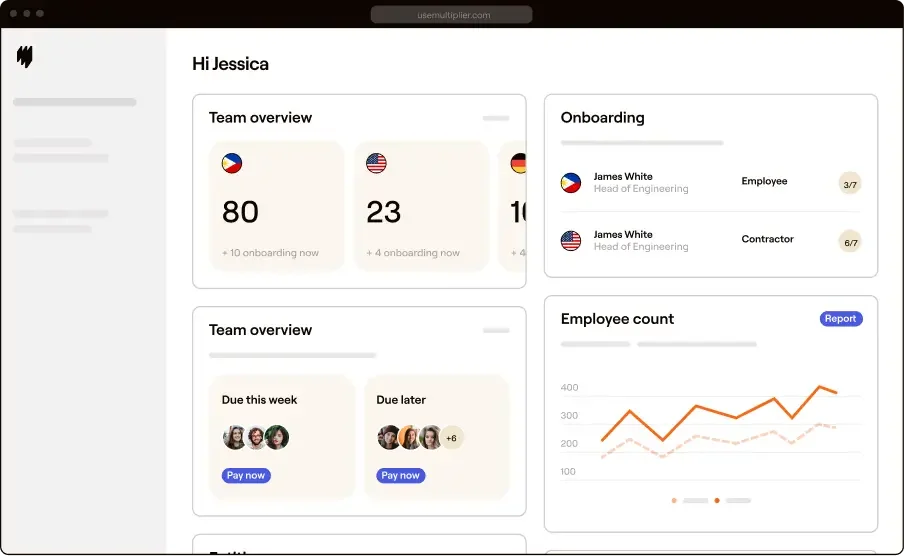
What Are the Key Differences Between Remote.com and Multiplier?
Five operational differences matter most when choosing between these providers. We’ve ranked them by how much they impact your day-to-day experience and long-term costs.
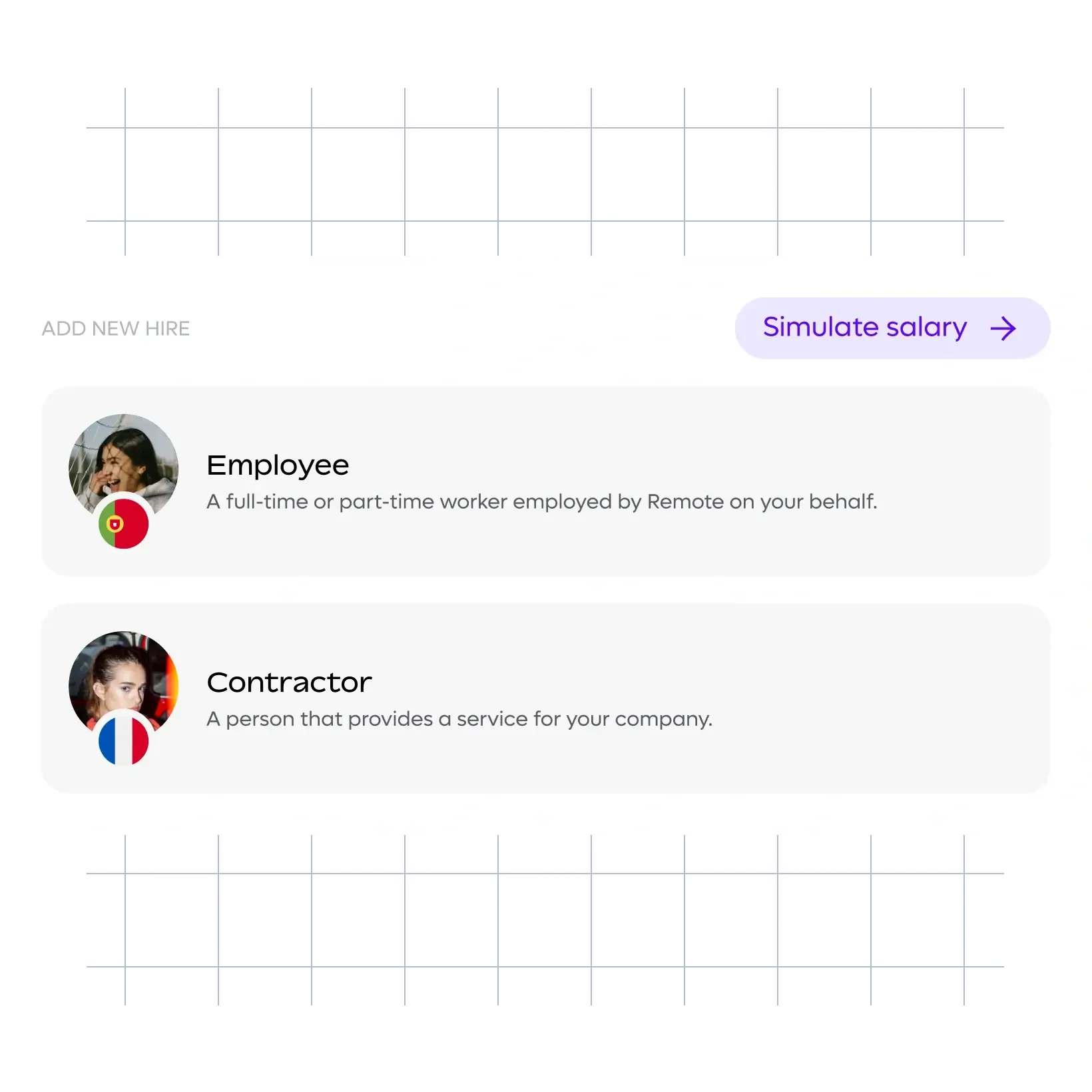
Best for Pricing
Multiplier wins on entry price; Remote wins on predictability. Multiplier’s published rate starts at $400 per employee per month against Remote’s $599 (paid annually, $699 monthly), and both are transparent flat fees rather than sales-led quotes. The catch on Multiplier is that the rate can climb to $450-500 in complex jurisdictions, while Remote charges the same wherever it owns the entity. Neither charges setup fees, and Remote takes no deposit at all.
Pricing scenario analysis
15-employee team across the US, UK and Germany. Remote runs about $8,985 a month at its flat $599 seat. Multiplier’s published $400 entry rate comes in lower at roughly $6,000 for the same team, before any complex-jurisdiction uplift, and drops further past 25 employees. For a mainstream-market team this size, Multiplier is usually the cheaper base; Remote’s edge is owning the entity in all three markets and never asking for a deposit.

Best for Compliance
Close, with different shapes. Remote owns its entities in 90+ core markets and emphasises a single owned chain of accountability there; Multiplier owns 100+ entities (UK, Singapore, India, Australia and more) and uses vetted partners beyond. Both are GDPR-compliant and SOC 2 and ISO 27001 certified (Multiplier also holds ISO 27017 and 27018). Where you are hiring into one of each provider’s owned markets, the compliance posture is comparable; the divergence is which provider owns the specific entity in your country, so confirm that for your priority markets.
Best for Country Coverage
Multiplier reaches wider; Remote owns deeper. Multiplier covers 150+ countries and is notably strong in Asia-Pacific (India, Singapore, the Philippines, Indonesia), often onboarding in 2-3 business days there. Remote owns entities in 90+ core markets and reaches 180+ countries through vetted partners, with its deepest service in the top global hiring destinations. If your map is APAC-heavy or long-tail, Multiplier; if it concentrates in major Western markets where you want the provider’s own entity, Remote.
Best for Support
Multiplier wins on included service. It provides 24/7 human-first support with a dedicated Customer Success Manager on every account plus a dedicated onboarding manager, not just enterprise tiers. Remote leans self-service: chat and email with a 24/7 AI assistant at the standard tier, and named account management reserved for larger accounts. If you want a human who owns your account from day one, that is Multiplier; if your HR team is happy self-serving, Remote’s model keeps costs down.
Best for Growth Stage Companies
It tracks your expansion path. A Series A-C company hiring 5-50 people in mainstream markets gets predictable budgeting and a deep owned footprint from Remote, with no deposit to tie up cash. A company scaling fast into Asia-Pacific or the long tail, or one that wants hands-on guidance while it learns new markets, gets wider reach, a lower entry price and a dedicated manager from Multiplier. The fork is less about size than about how exotic your hiring map is and how much you want to self-serve.
What Does Remote.com Bring to This Comparison?
What Remote.com Offers
Remote is a full employer-of-record and global-HR platform built on owned entities. It runs EOR at a flat $599 per employee per month (paid annually, $699 monthly), contractor management from $29, a Contractor of Record from $325 and Global Payroll Payments at $50 per employee. Contractors can be paid in 100+ currencies across 200+ jurisdictions, and the platform adds equity management (via Easop), recruitment and relocation support, and an employee mobile app.
Main Strengths
Deep owned-entity footprint. Remote directly owns employing entities in 90+ core markets including the UK, Germany, Netherlands and Portugal, reaching 180+ countries through vetted partners. In its owned markets it controls the whole employment relationship and can activate payroll within 24 hours and generate compliant contracts in minutes.
Transparent, predictable pricing. No surprises, no sales negotiations, no volume tiers to navigate, and zero deposit. Your CFO can calculate next year’s costs in a spreadsheet without calling sales.
Main Limitations
Thinner outside the owned core, and lean on support. Beyond its 90+ owned markets Remote falls back on partners like everyone else, so the “owned” advantage is strongest in mainstream markets. Named account management is reserved for larger accounts, standard-tier teams self-serve through chat, email and an AI assistant, and finance teams have flagged payroll reporting as basic for detailed cross-country variance analysis.
What Does Multiplier Bring to This Comparison?
Main Strengths
Wide reach on owned plus partner entities. Multiplier covers 150+ countries, owning 100+ entities (UK, Singapore, India, Australia and more) and vetting partners for the rest. It is particularly strong in Asia-Pacific, often onboarding in 2-3 business days in markets like Singapore and India, which reflects its Singapore headquarters.
Service included as standard. Every account gets 24/7 human-first support and a dedicated Customer Success Manager, with access to local HR and legal experts. Pricing is transparent and flat from $400, undercutting Remote’s entry rate.
Enterprise-grade flexibility. Multiplier supports ESOP and equity, instant employment contracts, integrated global payroll across your own entities, and complex benefits packages that a purely standardised approach struggles to accommodate.
Main Limitations
Partner-market variability and a less mature integration layer. Users report occasional delays or slower communication in partner (non-owned) markets, and Multiplier’s API and integration layer are seen as less mature for deep enterprise configuration. Reports on a native mobile app conflict (some say browser-only as of late 2025), so confirm that in writing if it matters to your team.
How Do Remote.com and Multiplier Compare on Features?
Employer of Record Services
Both run full EOR: compliant contracts, payroll, statutory benefits, taxes and terminations handled in-country. Remote does this on its own entities in 90+ markets at a flat $599, activating payroll within 24 hours where it owns the entity. Multiplier does it across 150+ countries from $400, bundling visas and work permits, benefits administration and HRMS modules (expenses, leave, timesheets) into the fee. The practical difference is footprint shape and price, not capability: Remote is deeper in mainstream markets, Multiplier wider and cheaper at entry.
Contractor Management
Remote charges $29 per contractor per month and tiers up the risk protection: Contractor Management Plus at $99 adds misclassification indemnity up to $100,000, and a Contractor of Record from $325 adds uncapped indemnity and IP protection. Multiplier charges $40 per active contract per month; its standard contractor documentation does not confirm misclassification liability coverage for the hiring company, so for high-risk engagements Remote’s CoR is the stronger shield. The general rule holds for both: the client carries the misclassification risk unless a Contractor of Record explicitly takes it on.
Global Payroll
Remote treats global payroll as a separate product line with distinct pricing. If you have entities in some countries but need EOR elsewhere, you’ll manage two different contracts and pricing models. The separation keeps each service focused but creates administrative overhead.
Multiplier bundles global payroll into its enterprise packages. You can run payroll for your own entities alongside EOR employees through one platform with unified reporting. The integration simplifies operations for companies with complex international structures.
HR Tools and Integrations
Remote integrates with Workday, Gusto, Greenhouse, Personio, Vanta, Carta, Slack, Zapier and Google Workspace among others, and its API is the more developer-friendly of the two for custom builds. Multiplier connects to Okta, Azure AD, Google Workspace, JumpCloud, Vanta, Workday, HiBob, SAP SuccessFactors, Personio, Workable and Tipalti, and exposes a public API, but its integration layer is the less mature for deep enterprise configuration and often leans on its account team for complex connections. For a plug-and-play HRIS sync, Remote; for hands-on integration help, Multiplier.
Onboarding and User Experience
Remote lets you self-register and, in its owned markets, activate payroll within 24 hours and generate compliant contracts in minutes. Multiplier also allows self-registration and onboarding in minutes, with instant employment contracts and a particularly fast 2-3 business days in APAC markets like Singapore and India. Both are modern, self-serve platforms; the experience diverges on support rather than the dashboard, with Multiplier pairing every account with a dedicated onboarding manager and Remote steering standard-tier users to self-service.
How Do Remote.com and Multiplier Compare on Pricing?
EOR Pricing
Remote lists a flat $599 per employee per month when paid annually, or $699 paid monthly, with no setup fee and no deposit. Multiplier publishes a transparent flat rate from $400, which can rise to $450-500 in complex jurisdictions and, by our EOR cost analysis, fall below $300 per month at higher volumes (around 25+ employees). So Multiplier is the cheaper entry point and rewards volume, while Remote trades a higher flat fee for a rate that never moves with your country mix. Multiplier typically asks for a refundable deposit on EOR (confirm the amount at quote); Remote takes none.
Contractor and Payroll Pricing
Remote’s contractor service costs $29 per person per month, straightforward but it adds up: a team of 20 contractors pays $580 a month just for payment processing. Remote’s Global Payroll Payments product is a published $50 per employee per month. Multiplier charges $40 per active contract and prices global payroll at $30 per employee.
Hidden Fees and Add-Ons
Remote bills extras as add-ons rather than baking them into the seat: benefits administration, visa and immigration support, and equity management (delivered via its Easop partnership). The exact rates are quoted per case, so ask for the full add-on schedule before signing rather than relying on a single headline number.
Multiplier’s bundled approach makes hidden fees less common, but pricing opacity creates different challenges. Setup fees, offboarding costs and amendment charges vary by partner and country.
Enterprise contracts might waive these fees, but smaller accounts often face unexpected charges for changes or terminations.
Which Offers Better Value?
For a mainstream-market team of 5-30, Multiplier usually wins on raw cost (a lower entry rate, volume discounts, support and a dedicated manager included) provided you are comfortable with a one-month deposit and some partner-market variability. Remote wins on value where predictability and owned-entity depth matter more than the lowest sticker: a fee that never moves, zero deposit, and direct control in its 90+ owned markets. Put simply, Multiplier is the better-value pick for APAC-heavy or cost-sensitive scaling; Remote for finance teams that prize a fixed, deposit-free number in major Western markets.
How Do Remote.com and Multiplier Compare on Compliance?
Entity Model
This is where the marketing oversimplifies. Remote owns entities in 90+ core markets and is owned-first there, reaching 180+ countries through vetted partners beyond that footprint. Multiplier owns 100+ entities (the UK, Singapore, India, Australia and more) and likewise uses a partner network for the rest. Both are hybrids; the honest distinction is depth and shape. Remote concentrates ownership in mainstream Western markets, Multiplier in Asia-Pacific, and outside each provider’s owned core you are relying on a partner either way, so confirm who holds the entity in your priority countries.
Legal Infrastructure
Remote maintains in-house legal teams for their primary markets. They directly control employment contract templates, policy updates, and compliance procedures. When regulations change, Remote implements updates across their entire entity network simultaneously.
Worker Classification and IP Protection
Remote’s standardised contracts include consistent IP assignment and confidentiality clauses adapted for each jurisdiction. Their legal team ensures enforceability across markets. The standardisation helps but may not accommodate unique IP structures some companies require.
Country-Specific Compliance Depth
Depth follows ownership. Remote is deepest in its 90+ owned Western markets; Multiplier is deepest in Asia-Pacific, where it owns entities and onboards in 2-3 days. On certifications the two are level: both are GDPR-compliant and SOC 2 and ISO 27001 certified, with Multiplier additionally holding ISO 27017 and 27018 and hosting on AWS. On UK hiring specifically, both run PAYE and HMRC reporting (Remote is an HMRC-recognised UK payroll provider; Multiplier automates UK PAYE, benefits and HMRC reporting and offers an NRE payroll option for Europe). One IR35 caveat applies to both: putting a UK worker on the EOR removes your IR35 exposure because the EOR is the employer, but for contractors engaged directly the classification risk can still rest with you unless a Contractor of Record takes it on.
How Do Remote.com and Multiplier Compare on Country Coverage?
Total Country Coverage
Multiplier reaches 150+ countries; Remote owns entities in 90+ core markets and reaches 180+ countries through vetted partners. Headline totals flatter both, because a chunk of each footprint runs on partners rather than owned entities. The number that matters is owned coverage in your specific markets, not the global tally, so treat 150+ and 180+ as reach, not as guarantees of owned depth everywhere.
Strength in Key Hiring Markets
Remote excels in the top 20 global hiring destinations. Their owned entities in the UK, Germany, Canada, and Australia provide the same service quality you’d expect from premium local providers. These markets represent 80% of international hiring for most companies.
Multiplier matches Remote’s quality in major markets while extending into secondary cities and regions. Need to hire in Manchester rather than London?
Bangalore rather than Delhi? Multiplier’s partners often have stronger regional presence outside capital cities.
Where Coverage Quality Differs
The gap shows up off the beaten track. In Asia-Pacific, Multiplier’s owned entities and 2-3 day onboarding give it the edge; in major Western markets, Remote’s owned chain is as deep or deeper. Where neither owns the entity, you inherit a partner relationship and the service can vary, which is exactly where buyers report the most friction. Check our EOR fee tool for a country-by-country read before you commit.
How Do Remote.com and Multiplier Compare on Support?
Account Management and Service Model
Remote reserves named account management for larger accounts; standard-tier customers rely on self-service chat, email and a 24/7 AI assistant. The model keeps costs low but frustrates teams expecting proactive guidance. Multiplier takes the opposite approach, assigning a dedicated Customer Success Manager to every account plus a dedicated onboarding manager, with access to local HR and legal experts.
Support Channels and Response Times
Remote promises 24-hour email response times and typically delivers. Chat support operates during extended business hours across time zones.
No phone support exists outside Enterprise tier. The asynchronous model works for routine questions but frustrates urgent issues.
Multiplier offers 24/7 human-first support (no bots) across email, chat and phone, with a dedicated account manager on every plan reachable directly. Response is particularly fast during APAC business hours, reflecting its Singapore base. The multiple channels and named contact help, though some users report slower communication on detailed requests in partner markets.
Customer Reviews and Common Issues
Remote reviews on G2 (4.5/5 from 850+ reviews verified April 2026) consistently praise platform usability but criticise support responsiveness for complex issues.
Common complaints include slow responses to termination requests and limited help with country-specific benefit questions.
Which Should You Choose: Remote.com or Multiplier?
Choose Remote.com If
- You’re a growth-stage company (Series A to C) hiring 5-50 employees primarily in established markets. Your finance team values predictable costs over lowest possible rates. Your HR team prefers self-service tools to relationship management.
Choose Multiplier If
- You’re scaling internationally (from a handful of hires up to enterprise) with hiring concentrated in Asia-Pacific or emerging markets beyond Remote’s owned core. You want a lower entry price, a dedicated account manager from day one, or customised contracts, special benefits and complex equity structures.
- Multiplier fits companies undergoing international expansion who value experienced guidance over self-service efficiency. If you’re entering new markets and need local expertise for navigation, their account management model provides valuable support.
Consider an Alternative If
- Neither model fits – the alternatives below cover broader coverage, employee experience, and enterprise scale.
What Are the Best Alternatives to Remote.com and Multiplier?
Deel
- For companies needing the broadest coverage on one platform: Deel. It covers 150+ countries through a hybrid owned-entity and partner model, with EOR from $599 and a deep contractor and global-payroll product set.
- Strong choice if you want EOR, contractors and payroll consolidated under one vendor.
- For companies prioritising employee experience and equity compensation: Oyster. Their platform leads the category in user experience design.
- Equity management comes built-in rather than bolted on. Pricing is published from around $599/month with transparent add-on costs.
- Oyster suits companies where employee satisfaction matters as much as operational efficiency. Their onboarding experience consistently receives the highest ratings among all providers.
- For enterprises that want maximum owned-entity depth and high-touch compliance: G-P runs 100+ wholly owned entities reaching 180+ countries.
- Pricing is custom-quoted and premium, so it suits compliance-first buyers willing to pay more and go through sales rather than self-serve on a published rate.
Check current pricing and plans
Open each provider to compare current pricing, plans, and setup details.
Provider links may be affiliate links where programmes are live.
Remote.com vs Multiplier: Frequently Asked Questions
Is Remote or Multiplier better for small teams?
It depends on what a small team values. Multiplier is actually the cheaper entry point (from $400 versus Remote’s $599) and includes a dedicated account manager and 24/7 support even on small accounts.
Remote’s edge for teams under 20 is its deep owned footprint in mainstream markets, zero deposit and a clean self-service model. Pick Remote if your hiring sits in its owned core and you prefer to self-serve; pick Multiplier if you want a lower price, a named contact, or coverage in Asia-Pacific and the long tail.
Which provider handles terminations better?
Both providers manage compliant terminations, but the experience differs. Remote’s standardised process works well in their owned-entity markets with clear timelines and costs.
Multiplier’s partner model provides more flexibility for complex terminations but requires more coordination and timeline varies by country.
Can I negotiate pricing with Remote?
Remote’s published rate is $599 per month paid annually ($699 monthly), and it does not run public volume tiers, so there is little room to negotiate the seat price; the main lever is annual versus monthly billing. Multiplier’s flat pricing starts lower at $400 and explicitly rewards volume, dropping below $300 at 25+ employees, so it is the more negotiable of the two at scale.
How do intellectual property protections compare?
Remote uses standardised IP assignment clauses adapted for each country’s laws. This consistency helps but limits customisation.
Multiplier can accommodate custom IP structures through their partners, beneficial for deep tech or research roles. Neither provider indemnifies for IP disputes.
Which integrates better with existing HRIS systems?
Both offer similar integration capabilities with mainstream HRIS platforms. Remote’s API is more developer-friendly for custom integrations.
Multiplier provides more hands-on integration support through their account teams, valuable for complex enterprise system connections but slower to implement.
How We Compared Remote.com and Multiplier
Whichapp is an independent comparison site for global payroll, EOR, and contractor management platforms. We do not sell these services and do not accept payment for editorial placement. We may earn a commission if you book a demo or request a quote through links on this page. This comparison was produced by our editorial team and was not reviewed or approved by either provider before publication.
Data Sources
- Provider pricing pages for both brands (verified April 2026)
- G2 and Capterra reviews for both brands (Jan–Apr 2026)
- Provider help centre documentation and country guides
- Whichapp provider score composite data (see sources & data)
Research Approach
- Pricing model and total employment cost
- Entity model and compliance infrastructure
- Country coverage depth and quality
- Platform usability and onboarding experience
- Customer support model and response standards
- Verified user feedback from G2 and Capterra
Both providers were assessed across the same six dimensions: pricing model and total employment cost, entity model and compliance infrastructure, country coverage depth and quality, platform usability and onboarding experience, customer support model and response standards, and verified user feedback from G2 and Capterra. Neither provider was engaged for a paid pilot or contract as part of this comparison.
Whichapp Research used in this comparison
- EOR Cost Benchmark: published EOR fee ranges and pricing model disclosure across providers
- EOR vs Entity Break-Even Benchmark: 40-country cost crossover analysis: when EOR becomes more expensive than entity setup