
Papaya Global vs Rippling
Papaya Global and Rippling represent opposite philosophies for solving international payroll. One assumes you have existing HR systems and need execution depth. The other assumes you want to replace multiple vendors with one platform.
The decision is not about feature counts. It is about whether your international expansion needs a specialized payroll engine or a unified platform that handles HR, IT, and Finance together.
Should you choose Papaya Global or Rippling?
Choose Papaya if you need multi-country payroll across 160+ countries with FX optimization. Choose Rippling if you want unified HR/IT/Finance from one US-centric platform.
| Compared |
PPapaya Global
|
RRippling
|
|---|---|---|
| Score (Whichapp composite, /10) | 8.2 | 6.4 |
| EOR price | $599flat per employee / month | QuoteEOR is quote-only; not publicly published |
| Best for | Choose Papaya if you need multi-country payroll across 160+ countries with FX optimization. | Choose Rippling if you want unified HR/IT/Finance from one US-centric platform. |
| Avoid if | Avoid Papaya if you lack existing HRIS infrastructure. | Avoid Rippling if you are not US-headquartered or need payroll in 100+ countries. |
| Key strength | 160+ country payroll via Tier-1 banking. | Unified HR/IT/Finance lifecycle automation. |
| Key weakness | No HRIS functionality, assumes existing systems. | US-centric design, limited to 80 EOR countries. |
| Bottom line | Finance-led enterprises needing payroll depth choose Papaya. | US tech companies wanting platform consolidation choose Rippling. |
The architectural difference shapes everything else. Papaya built for payroll depth across 160+ countries. Rippling built for platform breadth across HR, IT, and Finance modules.
Papaya Global vs Rippling at a glance
| Dimension | PPapaya Global |
RRippling |
|---|---|---|
| EOR pricing | $599/month flat | Quote-only (not published) |
| Global payroll | $25/employee/month | Native in 10 countries; quote-based |
| Contractor management | $30/month (AOR from $200) | Quote-based |
| Country coverage | 160+ payroll countries (~40 owned) | 80 EOR countries; pays 185+ |
| HRIS functionality | None (integrates with existing) | Full HRIS included |
| Base platform fee | None | $35/month + $8/user |
| IT management | None | MDM, app management |
Check current pricing and plans
Open each provider to compare current pricing, plans, and setup details.
Papaya Global
Official provider site
See current pricing, plans, and how setup works.
Rippling
Official provider site
See current pricing, plans, and how setup works.
Provider links may be affiliate links where programmes are live.
How Do Papaya Global and Rippling Compare Feature by Feature?
The full comparison reveals how platform philosophy drives capability differences. Papaya focuses on payment infrastructure. Rippling focuses on employee lifecycle integration.
| Capability | PPapaya Global |
RRippling |
|---|---|---|
| Entity model | Hybrid: ~40 owned (Papaya Direct) + partners | Owns US/UK/CA/AU, partners elsewhere |
| Native payroll engines | Limited (via partners) | 10 countries native, 50+ currencies |
| FX management | 1-1.5% via JP Morgan/Citi | Not disclosed |
| Payment infrastructure | Tier-1 banking partnerships | Standard payment rails |
| HRIS integration | Workday, SAP, Oracle, HiBob | Native HRIS (replaces others) |
| Compliance approach | 60-criteria partner vetting | Partner-managed compliance |
| Support model | Post-implementation decline noted | 51-second median response |
| Crypto payroll | Yes, with digital wallets | No |
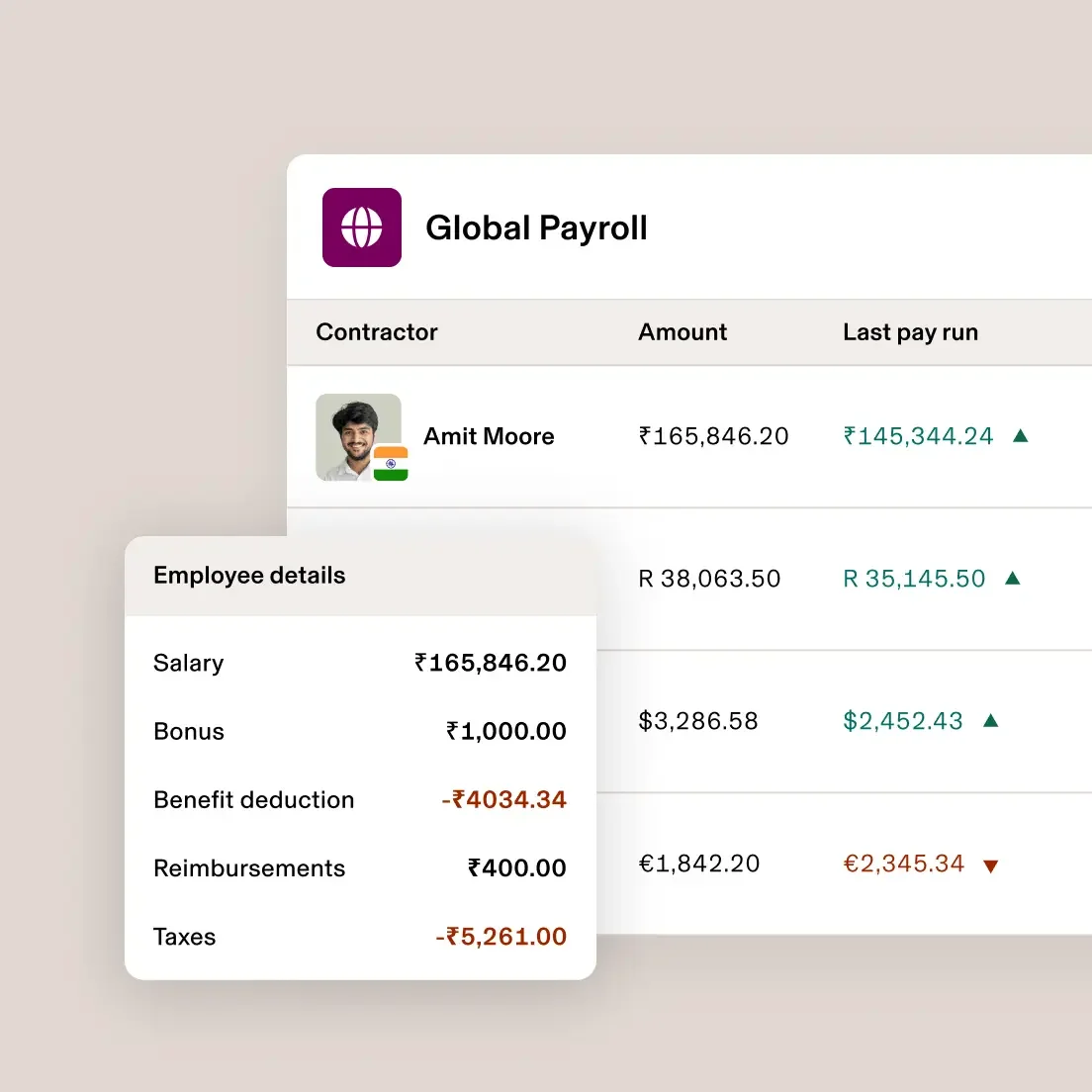
What Are the Key Differences Between Papaya Global and Rippling?
The fundamental difference: Papaya assumes you have HR systems and need payroll execution. Rippling assumes you want to consolidate multiple vendors into one platform that owns the entire employee lifecycle.

Best for Pricing
Rippling’s pricing complexity defeats simple comparison. The base platform fee of $35/month plus $8/user applies to ALL employees, including domestic staff. A 100-person US company paying for 50 US employees just to access international features faces hidden costs.
Papaya charges only for international employees. No base platform fees.
But setup fees per country and year-end filing fees add up. Neither provider wins on pure cost efficiency.
Best for Compliance
Roughly even, both hybrid. Papaya owns entities in around 40 markets (Papaya Direct) and uses vetted partners beyond; Rippling owns entities in the US, UK, Canada and Australia and partners elsewhere for its 80-country EOR. Both are HMRC-recognised for UK payroll (Rippling automates PAYE, NI, RTI and auto-enrolment; Papaya interacts with HMRC directly). On contractors, both flag IR35 status but leave the liability with the client. Neither is a pure owned-entity play, so confirm who holds the entity in your priority markets.
Best for Country Coverage
Papaya, for breadth. Papaya runs payroll across 160+ countries; Rippling’s EOR is 80 countries (it pays contractors in 185+, but that is not employment). If your map is wide or emerging-market-heavy, Papaya; if it concentrates in Rippling’s native-payroll markets, Rippling’s depth there is the draw. Rippling may need a second EOR for parts of Latin America, Africa or Southeast Asia.
Best for Support
Different shapes. Rippling publishes a fast median response (around 51 seconds for admin tickets) but skews to US business hours and chatbot-gated tiers, with phone reserved for higher plans. Papaya advertises 24/7 support across Help Center, email and WhatsApp with a dedicated Customer Success Manager, though users report responsiveness can dip after go-live. Pick Rippling for fast routine US-hours answers, Papaya for always-on coverage with a named contact.
Best for Platform Integration
Rippling, decisively. It is a unified HR, IT and Finance platform with native HRIS, device management, a Workflow Studio automation engine (100+ templates) and Compliance 360 alerts. Papaya has no HRIS of its own; it integrates into your existing Workday, SAP, Oracle or HiBob. If you want one platform to own the employee lifecycle, Rippling; if you want a payroll engine that slots under your current HRIS, Papaya.
What Does Papaya Global Bring to This Comparison?
What Papaya Global Offers
Papaya is a payments-first Workforce OS: EOR at a flat $599, standalone Global Payroll from $15-25, contractor management ($30) and an Agent of Record (from around $200) that shifts misclassification liability off the client. It owns entities in around 40 markets and uses partners to reach 160+ countries, with a Global Health Plan available across 160+, an employee self-service app (Papaya Personal), and strong security and compliance certifications (ISO 27001/27701, SOC 1/2 Type II).
Main Strengths
Payment infrastructure depth distinguishes Papaya. Tier-1 banking relationships enable 1-1.5% FX spreads versus industry-standard 2-3%. Treasury management features appeal to finance teams managing multi-million dollar international payroll.
Crypto payroll capability serves specific use cases. Digital wallet options and cryptocurrency payments work in countries with currency controls or where traditional banking fails.
Enterprise integration ecosystem covers major platforms:
- Workday
- SAP SuccessFactors
- Oracle HCM
- NetSuite
- plus mid-market systems like BambooHR and HiBob
Main Limitations
Papaya has no HRIS of its own, so it assumes you already run one; outside its ~40 owned markets it relies on partners, which can mean variability and the occasional implementation wobble (missed statutory payments, setup complexity). Contracts can run two years with a 90-day rolling notice, EOR fees sit on top of statutory employer costs (10-15% benefit markups, country surcharges), and support responsiveness can dip after go-live. Budget the all-in number, not the $599 headline.
What Does Rippling Bring to This Comparison?
What Rippling Offers
Rippling is a unified HR, IT and Finance platform: native HRIS localised for 85+ countries, native payroll in 10 countries (50+ currencies), EOR in 80 countries, device and app management, spend management, and a Workflow Studio automation engine. It is HMRC-recognised for UK payroll. Pricing is modular and quote-led, with a base platform fee billed across your whole headcount plus per-module costs.
Main Strengths
Workflow automation across domains creates genuine efficiency. IT provisioning that typically requires separate MDM solutions happens within HR workflows. Finance visibility spans from headcount planning to expense actuals.
Native payroll engines in 7 countries provide direct control over tax calculations and compliance. The US payroll engine particularly excels at multi-state complexity.
Platform breadth enables single-vendor relationships for growing companies. One contract, one renewal, one support relationship replaces typical 5-10 vendor portfolios.
Main Limitations
Rippling is US-centric and its EOR reaches only 80 countries, so global-heavy buyers may need a second provider for parts of Latin America, Africa or Southeast Asia. The base platform fee applies across all employees, which can mean paying for domestic staff just to access international features, and minimum seat counts can leave you paying for headcount you no longer have. Users report UK edge cases (IR35, complex statutory pay) get lighter coverage than the US, support skews to US hours, and there have been isolated security complaints.
How Do Papaya Global and Rippling Compare on Features?
Employer of Record Services
Papaya runs EOR across 160+ countries at a flat $599, owning entities in around 40 markets and using partners elsewhere, with a 100% compliance liability guarantee. Rippling’s EOR covers 80 countries (quote-only), owning entities in the US, UK, Canada and Australia and partnering elsewhere. Papaya wins on breadth and price transparency; Rippling wins when the EOR must plug into its native HRIS and IT stack.
Contractor Management
Papaya’s Contingent OS launched June 2025 at $30/month per contractor. Includes classification compliance reviews and consolidated invoicing. Payment infrastructure handles complex cross-border scenarios.
Global Payroll
Papaya’s $25/employee/month pricing beats Rippling’s reported ~$200/month for multi-country payroll. But price alone misleads without understanding capability differences.
Rippling’s native engines in 7 countries provide direct tax calculation control. Papaya relies on country partners for local calculations. Data residency and audit trail ownership vary accordingly.
Payment timing reliability favors established Papaya infrastructure over Rippling’s newer international rails. Treasury teams value predictable funding requirements.
HR Tools and Integrations
This is the sharpest divide. Rippling IS the HR system: native HRIS, IT/device management, spend management and Workflow Studio automation, designed to replace your existing tools. Papaya has no HRIS; it integrates into Workday, SAP SuccessFactors, Oracle HCM, NetSuite, BambooHR and HiBob, with out-of-the-box connectors included in the payment solution price. If you want to consolidate tools, Rippling; if you want to keep your HRIS and add payroll depth, Papaya.
Onboarding and User Experience
Papaya offers a self-service, five-step client onboarding that can bring existing payroll onto the platform in as little as a few weeks, with a dedicated project and implementation manager. Rippling’s system onboarding typically runs two to four weeks depending on complexity, and some UK buyers note the platform reads as US-first and modified for UK process. Both are modern; Papaya leans payroll-implementation, Rippling leans full-platform rollout.
How Do Papaya Global and Rippling Compare on Pricing?
EOR Pricing
How the two price EOR
Papaya: a flat, published $599 per employee per month, with no base platform fee, plus one-time setup fees per country and statutory employer costs on top. You can model it before talking to sales.
Rippling: EOR is quote-only, so there is no published per-employee figure to compare; its modular platform fees (HR, payroll, IT) are billed across your whole headcount, including domestic staff. Get the EOR quote and the platform-fee base in writing before comparing, because the all-in shape differs from Papaya’s single line.
Contractor and Payroll Pricing
Papaya’s contractor management at $30/month, but classification risk remains with the employer (its Agent of Record, from around $200, is the option that shifts that liability). Rippling prices contractors by quote.
Hidden Fees and Add-Ons
On Papaya, watch per-country setup fees, year-end filing fees, 10-15% benefit markups, country-complexity surcharges and statutory employer costs on top of the $599. On Rippling, the base platform fee applies across all employees, modules (payroll, IT, spend) stack on per-employee, minimum seat counts can bite, and the EOR itself is quote-only. Both should be priced all-in, in writing, before you compare.
Which Offers Better Value?
For a finance-led team that already runs an HRIS and wants transparent, modellable payroll across many countries, Papaya is the better value at a flat $599. For a US-centric company that wants to collapse HR, IT and payroll into one platform and hires within Rippling’s native-payroll markets, Rippling’s consolidation can outweigh its quote-only opacity. The value question is really: do you want a payroll engine under your stack, or a stack that includes payroll.
How Do Papaya Global and Rippling Compare on Compliance?
Entity Model
Both are hybrids, not pure owned-entity plays. Papaya owns entities in around 40 markets (Papaya Direct) and uses vetted partners across the rest of its 160+ countries; Rippling owns entities in the US, UK, Canada and Australia and partners for the remainder of its 80-country EOR. Outside each provider’s owned footprint you inherit a partner relationship, so confirm who holds the entity in your priority markets and how data residency is handled under UK GDPR.
Legal Infrastructure
Papaya’s much-touted “60-criteria partner evaluation” sounds impressive until you ask for specifics. What are the criteria? How often are partners re-evaluated?
Which partners failed evaluation? The silence is telling.
Worker Classification and IP Protection
Neither platform offers meaningful classification protection. Papaya’s Contingent OS and Rippling’s contractor payments provide classification guidance but no liability coverage.
IP assignment varies by country partner. Unlike owned-entity providers who standardize IP protection, partner-dependent models create inconsistent protection based on local partner contracts.
On UK hiring, both are HMRC-recognised: Rippling automates PAYE, NI, student-loan deductions, tax codes, RTI and pension auto-enrolment, while Papaya interacts with HMRC directly through its local compliance model. Both surface IR35 status but leave a directly-engaged contractor’s classification risk with the client; routing a UK worker through the EOR removes that exposure. Note that some users find Rippling’s UK edge cases (IR35, complex statutory pay) get lighter coverage than its US core.
Country-Specific Compliance Depth
Depth tracks where each owns or runs natively. Rippling is strongest in its native-payroll markets (US, UK, Canada, Australia and others) where it controls tax calculation directly. Papaya’s strength is breadth across 160+ countries, including emerging markets Rippling does not reach, handled through vetted partners. For a hard single market you want owned, check which provider actually owns it; for a wide spread, Papaya’s reach wins.
How Do Papaya Global and Rippling Compare on Country Coverage?
Total Country Coverage
Papaya enables payroll processing in 160+ countries through its partner network. Useful for companies with dispersed workforces across emerging markets. Coverage includes markets other providers skip.
Rippling’s 80-country EOR limitation forces creative solutions for broader coverage needs. The contractor payment network (185+ countries) provides partial workaround but without employment protections.
Strength in Key Hiring Markets
Rippling’s native payroll engines, in 10 countries including the US, UK, Canada, Australia, France, India and Ireland, provide measurable advantages: faster processing, direct tax control and unified reporting.
Papaya lacks native presence in these markets, routing everything through partners. The architectural choice trades control for coverage breadth. Fine for 10-person teams, problematic at scale.
Where Coverage Quality Differs
Asia-Pacific coverage reveals platform differences. Papaya’s established presence handles Singapore, Hong Kong, Japan requirements well. Rippling’s US-centric design creates friction with APAC compliance norms.
Latin America coverage favors neither strongly. Both rely on variable-quality partners. Companies prioritizing LATAM expansion should evaluate Remote or Deel’s owned entities in Brazil, Mexico, and Colombia.
How Do Papaya Global and Rippling Compare on Support?
Account Management and Service Model
Enterprise Papaya deployments receive dedicated account management during implementation. Post-implementation support transitions to shared teams where response quality reportedly declines.
Support Channels and Response Times
Rippling publishes 51-second median response time for admin tickets. Impressive metric that reflects narrow support scope and US business hours focus. International time zone coverage remains limited.
Papaya offers email and chat support with unpublished response targets. Customer reports indicate 24-48 hour response times for non-critical issues. Payment emergencies receive faster attention.
Customer Reviews and Common Issues
G2 reviews surface consistent Papaya complaints: payment timing problems during implementation, setup complexity exceeding expectations, support responsiveness declining after go-live.
Which Should You Choose: Papaya Global or Rippling?
Choose Papaya Global If
- You run finance or operations at an enterprise with established Workday, SAP, or Oracle HRIS. Your expansion spans 15+ countries across developed and emerging markets. Treasury management and FX optimization matter given payroll scale.
Choose Rippling If
- You lead People Operations at a US-headquartered company between 50-500 employees. Platform consolidation during Series A-C growth drives vendor selection. IT device management matters as much as HR and payroll.
- Your international presence concentrates in Rippling’s 7 native payroll countries. Workflow automation across HR, IT, and Finance creates measurable efficiency gains. Your team lacks bandwidth for multi-vendor management.
Consider an Alternative If
- You prioritize compliance certainty through owned-entity models. Neither Papaya nor Rippling provides the legal infrastructure of Remote or Deel in major markets. Partner dependencies create unacceptable risk for some businesses.
What Are the Best Alternatives to Papaya Global and Rippling?
Remote.com
For compliance-first companies: Remote. Owned-entity-first, owning entities in around 90 markets and reaching 180+ via vetted partners, providing direct employment relationships with strong IP protection versus partner-dependent models.
Pricing at $599/month (paid annually) matches Papaya’s flat fee. Its deep owned base justifies the cost for risk-averse enterprises. Best alternative when compliance certainty in mainstream markets outweighs raw coverage breadth.
Deel
For contractor-heavy workforces: Deel. Its Contractor of Record (from $325/month) transfers classification risk, alongside a broad EOR, payroll and HR set wider than single-purpose platforms.
Recent acquisitions (Hofy for IT management, PaySpace for payroll) position Deel as emerging Rippling alternative. Still lacks platform maturity but trajectory suggests future parity.
Oyster
For mid-market simplicity: Oyster. Transparent EOR pricing from around $599/month without hidden complexity. Modern platform design appeals to remote-first companies.
Check current pricing and plans
Open each provider to compare current pricing, plans, and setup details.
Papaya Global
Official provider site
See current pricing, plans, and how setup works.
Rippling
Official provider site
See current pricing, plans, and how setup works.
Provider links may be affiliate links where programmes are live.
Papaya Global vs Rippling: Frequently Asked Questions
Which is better for global payroll consolidation?
Papaya Global wins for pure payroll consolidation across 160+ countries. Purpose-built for multi-country complexity with superior payment infrastructure. Rippling better for US-centric companies wanting unified HR+IT+Finance.
How do the platforms differ for US-headquartered companies?
Rippling built specifically for US companies. Native US payroll, benefits, and compliance deeply integrated.
Papaya treats US as one of 160+ countries without special optimization. Clear advantage Rippling for US-centric operations.
What are the real cost differences beyond published pricing?
Rippling’s base platform fee ($35/month + $8/user) applies to ALL employees including domestic. Papaya charges per-country setup fees ($1,000-5,000).
Both charge FX markups. Model your specific scenario for accurate comparison.
Which platform handles FX and payment complexity better?
Papaya Global Tier-1 banking partnerships (JP Morgan, Citi) enable 1-1.5% FX spreads. Rippling FX costs unpublished but likely 2-3% standard range. Treasury teams prefer Papaya’s payment infrastructure.
How do the entity models compare for compliance risk?
Both use partner-dependent models without owned entities. Equal compliance risk despite Papaya’s 60-criteria vetting claims. Companies needing owned-entity certainty should evaluate Remote or Deel instead.
Which integrates better with existing HRIS systems?
Papaya built for HRIS integration with pre-built connectors for Workday, SAP, Oracle, HiBob. Rippling expects to replace your HRIS entirely. No middle ground – choose based on existing infrastructure investment.
What IT management capabilities does each offer?
Rippling includes broad IT management: device deployment, app provisioning, SCIM/SSO orchestration. Papaya offers zero IT functionality. Decisive advantage Rippling for tech-forward companies.
How do support experiences compare?
Mixed reviews for both. Rippling touts 51-second response times but restricts support to admins only.
Papaya support quality reportedly declines after implementation. Neither matches Remote’s 24/7 coverage.
Which works better for contractor payments?
Rippling covers more countries (185+ vs Papaya’s focus markets) but offers minimal compliance protection. Papaya’s Contingent OS provides better classification tools at $30/month. Neither transfers liability like Deel’s contractor-of-record.
What expansion stage suits each platform best?
Rippling suits Series A-C US companies consolidating vendors (50-500 employees). Papaya suits established enterprises with existing HRIS infrastructure (200+ employees, 15+ countries). Misalignment creates expensive switching costs later.
How We Compared Papaya Global and Rippling
Whichapp is an independent comparison site for global payroll, EOR, and contractor management platforms. We do not sell these services and do not accept payment for editorial placement. We may earn a commission if you book a demo or request a quote through links on this page. This comparison was produced by our editorial team and was not reviewed or approved by either provider before publication.
Data Sources
- Provider pricing pages for both brands (verified April 2026)
- G2 and Capterra reviews for both brands (Jan–Apr 2026)
- Provider help centre documentation and country guides
- Whichapp provider score composite data (see sources & data)
Research Approach
- Pricing model and total employment cost
- Entity model and compliance infrastructure
- Country coverage depth and quality
- Platform usability and onboarding experience
- Customer support model and response standards
- Verified user feedback from G2 and Capterra
Both providers were assessed across the same six dimensions: pricing model and total employment cost, entity model and compliance infrastructure, country coverage depth and quality, platform usability and onboarding experience, customer support model and response standards, and verified user feedback from G2 and Capterra. Neither provider was engaged for a paid pilot or contract as part of this comparison.
Whichapp Research used in this comparison
- EOR Cost Benchmark: published EOR fee ranges and pricing model disclosure across providers
- EOR vs Entity Break-Even Benchmark: 40-country cost crossover analysis: when EOR becomes more expensive than entity setup