
Gusto vs Rippling
Gusto and Rippling sit on opposite ends of the US workforce-software market. Gusto is a small-business payroll and benefits product. Rippling is a multi-module HR, IT, and Finance platform that happens to include payroll.
If you run 5 to 50 US employees and never plan to hire abroad as a full employee, Gusto wins on simplicity and price. If you have international hires in the next 12 months and a CFO wanting one vendor instead of seven, Rippling wins on consolidation.
Gusto vs Rippling at a glance
Gusto wins on US-only payroll simplicity, integrated benefits brokerage and transparent month-to-month pricing; Rippling wins on unified HR + IT + Finance, native payroll in 7 countries plus EOR in 80, and lifecycle automation that no other platform matches.
Choose Gusto if you employ 1 to 100 US staff, want predictable month-to-month pricing with no setup fees, need an integrated benefits broker, and pay 1 to 5 international contractors at most.
Choose Rippling if you are scaling past 50 employees, have international hires beyond 1 or 2 contractors, want IT device management on the same record as payroll, and your CFO has asked to consolidate vendors rather than pay seven separate bills.
Rippling raised $200 million in 2024 at a $13.5 billion valuation and serves more than 14,000 businesses.
The product spans HRIS, US payroll, native global payroll in 7 countries, EOR in 80 countries via partners, contractor payments in 185+ countries, MDM, app management, SSO, expenses, and bill pay. Every employee on Rippling sits on a paid HRIS seat.
| Compared |
GGusto
|
RRippling
|
|---|---|---|
| Score (Whichapp composite, /10) | 3.7 | 6.4 |
| Price from | Simple plan $49/mo base + $6/employee/mo, Plus $80 + $12/ee, Premium $180 + $22/ee. Month-to-month with no contracts or setup fees. Contractor-only plan $6/contractor/mo. EOR $599-699/ee/mo via Remote partnership. | HRIS base $35/mo + $8/user, with US payroll, IT Cloud, Finance and EOR added as separate modules. Annual commitment with minimum user counts. EOR quote-based $499-1,000/ee/mo. Non-refundable fees. |
| Best for | US-based small businesses with 5-50 employees who want simple payroll with built-in benefits brokerage (health, dental, vision, 401(k) via Guideline) and transparent month-to-month pricing, plus first-time payroll setup for non-technical owners. | Fast-growing tech-forward teams consolidating HR, IT and Finance into one platform with lifecycle automation (one trigger ships a laptop, provisions Okta and Slack, enrols payroll and benefits) plus international expansion into 80 EOR countries. |
| Deal breaker | Effective scaling ceiling around 100-200 employees per reviewer feedback, no IT device management, EOR is white-labelled from Remote (3-way support chain through 11 countries only), and support quality has degraded with reports of multi-month tax-error resolution. | Annual commitment with minimum user counts and non-refundable fees create lock-in, modular per-module pricing is hard to forecast, base $8/user platform fee is mandatory for every employee including EOR hires, and admin-only support routes every employee query through HR. |
Open each provider to compare current pricing, plans, and setup details.
How Do Gusto and Rippling Compare Feature by Feature?
| Dimension | GGusto |
RRippling |
|---|---|---|
| Headquarters | San Francisco, US | San Francisco, US |
| Founded | 2011 | 2016 |
| Valuation | ~$9.6B private | $13.5B (2024 round) |
| Customers | ~300,000 US businesses | 14,000+ globally |
| Sweet spot | 1 to 100 US employees | 10 to 2,000 employees, mixed US/intl |
| US payroll base price | $49/mo + $6/employee (Simple) | $35/mo + $8/user + ~$8/employee Payroll |
| Mid-tier price | $80/mo + $12/employee (Plus) | Quote-based; typical $14 to $18 PEPM |
| Contractor payments | $6/contractor/mo, 120+ countries | Quote-based, 185+ countries |
| EOR coverage | 11 countries via Remote | 80 countries via partners |
| EOR price | Quote-based (Remote rate card) | ~$499 to $1,000/employee/mo + base |
| Native global payroll | None | 7 countries (US, CA, UK, IE, FR, AU, IN) |
| Benefits broker | Yes, in-house, all 50 states + DC | Yes, in-house, all 50 states |
| IT / device management | Not offered | MDM, app provisioning, SSO, inventory |
| Implementation | Hours to days, self-serve | 2 to 8 weeks, varies by module |
| Contract terms | Month-to-month, no setup fee | 12-month commitment standard |
| G2 rating | 4.5 / 5 (1,800+ reviews) | 4.8 / 5 (2,400+ reviews) |
What Are the Key Differences Between Gusto and Rippling?
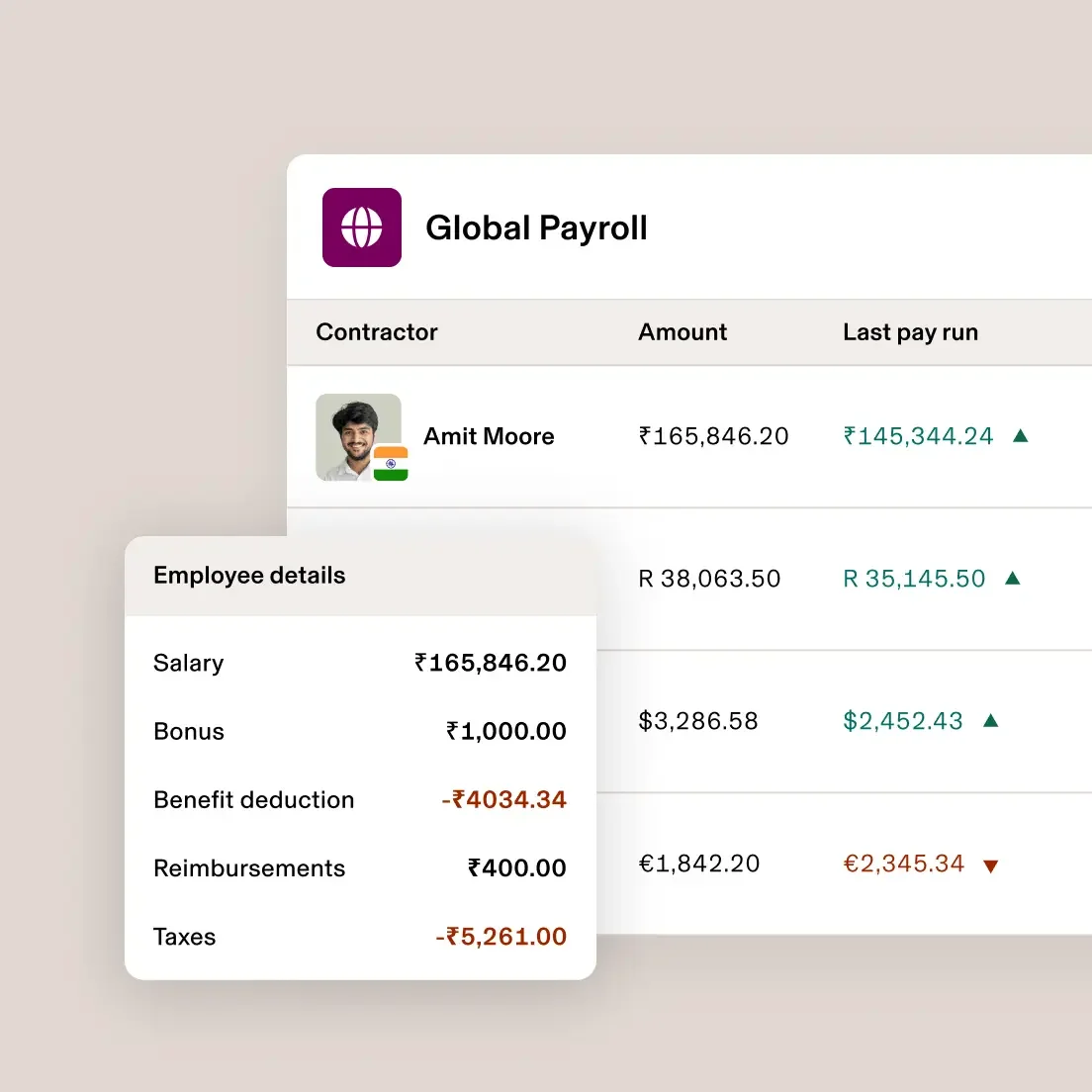
Product scope: Gusto is payroll and benefits. Rippling is a workforce platform with two dozen modules. Choosing between them means choosing depth in payroll and benefits or breadth across HR, IT, and Finance.
International reach: Gusto pays contractors in 120+ countries and EOR in 11 countries through Remote, and you must run Gusto US payroll first. Rippling pays contractors in 185+ countries, runs native global payroll in 7 markets, and offers EOR in 80 countries via partners.
IT and device management: Rippling provisions and wipes laptops, manages SSO, controls app access, and tracks device inventory. For a 100-person tech company, that replaces a Jamf or Kandji subscription costing $15 to $25 per device per month.
What Does Gusto Offer for a US Small Business?
Gusto launched in 2011 as ZenPayroll. It dominates the accountant channel through a Partner programme letting bookkeepers manage multiple clients on one console.
The core product is full-service US payroll with automated federal, state, and local tax filings in all 50 states. That includes messy stacks: Pennsylvania local taxes, Ohio school district withholding, New York City/Yonkers.
Benefits administration is in-house. Gusto is a licensed health insurance broker in all 50 states + DC (the 11-state limit applies only to some tax-advantaged accounts, not brokerage). The 401(k) integration with Guideline carries no separate admin fee for the employer.
US contractor payments are $6/month each; international contractor payments carry no monthly fee, only a per-payment service and FX charge (wire transfers start at a $15 minimum on payments under $1,000), across 120+ countries. EOR is delivered through Remote in 11 countries with pricing on Remote’s rate card, and Gusto Global requires you to be running Gusto US payroll for at least one US employee first. Gusto supports UK auto-enrolment pensions through its EOR partner but is not HMRC-recognised and offers no IR35 tooling.
What Does Rippling Offer Beyond Payroll?
Rippling launched in 2016 with one thesis: every employee record (HR, payroll, devices, apps, expenses) should live in one database. Onboarding a new hire triggers payroll setup, benefits enrolment, laptop shipment, app provisioning, and SSO configuration in a single workflow.
The base platform is Rippling Unity, the HRIS layer every customer pays for. Modules stack on top: US Payroll, Global Payroll (7 countries), EOR (80 countries via partners), Contractor Payments, IT, and Spend.
Rippling can lock a terminated employee out of every SaaS app, retrieve their MacBook, and zero their final paycheck in one offboarding workflow. Gusto cannot.

How Do Gusto and Rippling Compare on Pricing?
Gusto’s tiers are public: Simple is $49/month plus $6/employee. Plus is $80/month plus $12/employee.
Contractor-only plans run $6/contractor/month with no platform fee. No setup fees, no annual commitments.
Rippling’s pricing is modular: Unity base starts at $35/month plus $8/user/month for HRIS only. Each module carries its own per-user fee, typically $4 to $14 PEPM.
Most payroll-plus-HRIS deployments land at $14 to $18 PEPM all-in. EOR sits at $499 to $1,000 per employee per month plus the base fee on every domestic seat. Contracts are 12 months with annual renewal.
The 30-employee comparison: Gusto Plus runs $440/month for 30 US employees. Rippling Unity plus US Payroll at $16 blended pays $480/month. The two land within 10% of each other for the simple case.
The 60-employee comparison with EOR: Gusto Plus on 50 domestic plus Remote EOR on 10 lands at $7,000 to $9,700/month. Rippling on all 60 plus US Payroll on 50 plus EOR on 10 lands at $6,500 to $11,500/month.
Rippling is competitive at the lower EOR end and loses on flexibility because every domestic seat is locked in. Volatile headcount picks Gusto’s monthly billing. Stable growth accepts Rippling’s annual contract.
How Do Gusto and Rippling Compare on Compliance and Country Coverage?
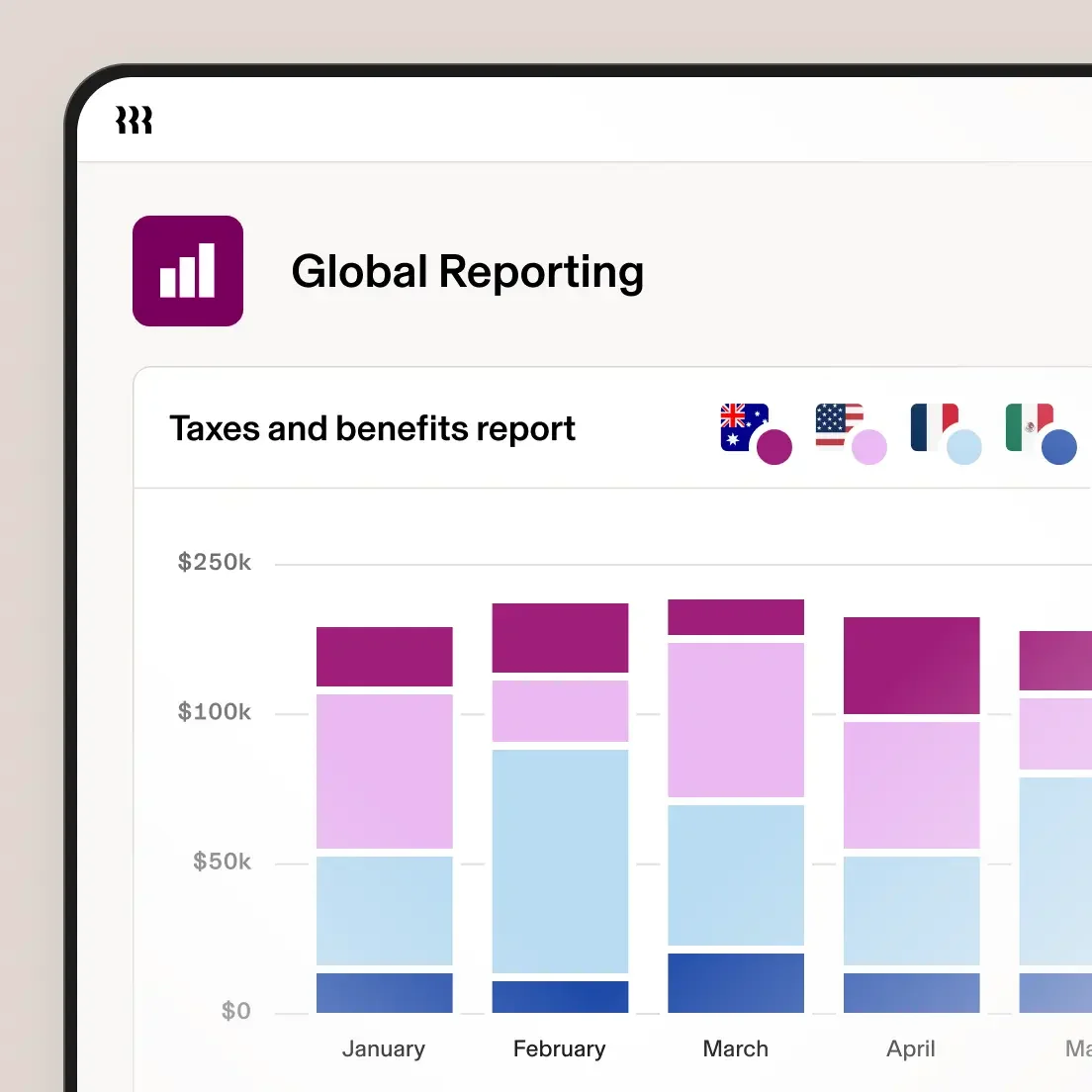
Both handle federal, state, and local payroll tax filings in all 50 states plus W-2/1099 generation. Gusto’s edge is depth in messy state-and-local stacks. Rippling has more support tickets reported on local-tax edge cases.
Country coverage is not the same league. Gusto: US plus 11 EOR countries via Remote. Rippling: native global payroll in 7 markets, EOR in 80 countries via partners.
If your hiring plan touches Singapore, South Africa, Colombia, or Vietnam, Gusto cannot help. In Rippling’s 7 native markets, Rippling owns the payroll engine; in the 73 partner EOR markets, a local partner is the legal employer. Ask which partner sits behind your target country before signing.
On UK and compliance specifics Rippling pulls ahead: it is an HMRC-authorised payroll provider, addresses IR35 with classification tools and a Contractor of Record that takes on misclassification liability, holds SOC 2 and ISO 27001 with EU data residency, and onboards a hire in as little as 90 seconds. Gusto, by contrast, is not HMRC-recognised, offers no IR35 tooling, and has no employer mobile app.
How Do Gusto and Rippling Compare on Support and Implementation?
Gusto offers phone, chat, and email Monday to Friday 6am to 5pm Pacific, with phone included on all paid tiers. Chat response sits in the 5 to 15 minute range during business hours. First payroll runs within hours for a self-serve small business.
Rippling defaults to email and chat. Phone access bundles at higher tiers and on EOR contracts. Implementation runs 2 to 8 weeks with a dedicated implementation manager.
Open each provider to compare current pricing, plans, and setup details.
Which Should You Choose: Gusto or Rippling?
Under 50 staff, all US: Gusto. 50 to 500 staff with real international plans: Rippling. Above 500 with significant international footprint: shortlist Rippling against Deel and standalone EOR providers.
Choose Gusto when
- You are a US small business with simple international needs, you value transparent pricing and month-to-month flexibility, and you are leaving QuickBooks Payroll, Paychex, or ADP Run.
Choose Rippling when
- You are scaling past 50 employees, you have international hires beyond 1 or 2 contractors, you want IT device management on the same record as payroll, and your CFO has asked to consolidate vendors.
Choose neither when
- Your primary hiring is international EOR with little US footprint (look at Deel, Remote, or Multiplier), or your headcount is above 1,000 with complex multi-country payroll.
What Are the Best Alternatives to Gusto and Rippling?
Switching from Gusto for cheaper benefits: Justworks. Bundles payroll, benefits, and PEO services, giving small companies access to large-group health rates. Best for 10 to 50 person companies prioritising cheaper health insurance.
Switching from Rippling for stronger international depth: Deel. Covers EOR in 150+ countries with owned entities in core markets. For buyers with more than 30% of headcount overseas, Deel is more international-native.
Switching from either for modular HR without lock-in: BambooHR plus Gusto. A common pairing for 50 to 200 person companies that want HRIS depth without committing to a Rippling contract.
Switching from Rippling for pure international EOR: Multiplier or Remote. If US payroll is settled and you only need EOR, standalone providers are cheaper than buying Rippling’s base platform plus EOR module.
Gusto or Rippling: Which Operating Model Fits Where You Are Today?
Sarah’s team usually knows within 30 minutes of demoing both which one is built for them. The common mistake is a 30-person US company signing Rippling because the demo is impressive, then paying for HRIS seats on staff who only need payroll.
The opposite mistake is a 120-person tech company sticking with Gusto for two years past the natural switch point. They end up paying Jamf, Okta, BambooHR, and Gusto bills that exceed what Rippling charges for the same record set. Pick on operating model, not demo polish.
How We Compared Gusto and Rippling
Whichapp is an independent comparison site for global payroll, EOR, and contractor management platforms. We do not sell these services and do not accept payment for editorial placement. We may earn a commission if you book a demo or request a quote through links on this page. This comparison was produced by our editorial team and was not reviewed or approved by either provider before publication.
Data Sources
- Provider pricing pages for both brands (verified April 2026)
- G2 and Capterra reviews for both brands (Jan–Apr 2026)
- Provider help centre documentation and country guides
- Whichapp provider score composite data (see sources & data)
Research Approach
- Pricing model and total employment cost
- Entity model and compliance infrastructure
- Country coverage depth and quality
- Platform usability and onboarding experience
- Customer support model and response standards
- Verified user feedback from G2 and Capterra
Both providers were assessed across the same six dimensions: pricing model and total employment cost, entity model and compliance infrastructure, country coverage depth and quality, platform usability and onboarding experience, customer support model and response standards, and verified user feedback from G2 and Capterra. Neither provider was engaged for a paid pilot or contract as part of this comparison.
Whichapp Research used in this comparison
- EOR Cost Benchmark: published EOR fee ranges and pricing model disclosure across providers
- EOR vs Entity Break-Even Benchmark: 40-country cost crossover analysis: when EOR becomes more expensive than entity setup