
Deel vs G-P
Choosing between Deel and Globalization Partners (G-P) means picking a side in the fundamental EOR philosophy debate: platform efficiency or compliance certainty.
This isn’t about feature lists. It’s about whether you trust a newer multi-product platform with published, aggressive pricing or pay a premium for an established compliance-first specialist with a deeper owned-entity footprint (100+ wholly owned entities) and high-touch service.
The real decision sits at the intersection of your risk tolerance, budget constraints, and whether you need EOR services alone or a full workforce management platform.
Should you choose Deel or G-P?
Choose Deel if you need integrated EOR, contractor, and payroll management at competitive rates; choose G-P if you prioritize compliance certainty through owned entities and high-touch service.
| Compared |
DDeel
|
GG-P
|
|---|---|---|
| Score (Whichapp composite, /10) | 9.1 | 7.6 |
| EOR price | $599Published from $599/employee/month. Volume discounts at 20+ employees. | CustomNo public EOR price; quote-based and premium, reported well above Deel's $599. 25% platform-fee promotion advertised. |
| EOR pricing model | Published, flat per employee | Custom quote (sales conversation required) |
| Core positioning | Multi-product workforce platform | Premium owned-entity EOR |
| Entity model | Owns 100+ entities, partners beyond (split not publicly disclosed) | 100+ wholly owned entities; most hires on owned, partners beyond |
| Service model | Platform self-service dominant | High-touch account management |
| Best for | Mixed workforce, cost-conscious | Enterprise compliance priority |
| Key difference | Both own 100+ entities, but G-P places a deeper share of hires on its own; the other fork is product breadth and pricing model | Pay a premium for G-P’s deeper owned-entity footprint and high-touch compliance, or take Deel’s published pricing and broader product surface |
Provider links may be affiliate links where programmes are live.
Compare alternatives to Deel · Compare alternatives to G-P
Deel vs G-P – verdict · Last checked: 2026-04-08
Deel wins on product breadth and transparent $599 published pricing for fast-scaling teams; G-P wins on its deeper owned-entity footprint (100+ wholly owned entities reaching 180+ countries), in-house legal depth in complex jurisdictions and audit-grade compliance for enterprise buyers willing to pay a premium and go through a sales quote.
Price from
Deel
EOR from $599/mo per employee standard (volume discount to $400-500 at 20+ headcount), contractor $49/mo, Contractor of Record $325/mo with misclassification liability transfer, no setup fees, free HRIS up to 200 employees.
G-P
EOR is custom-quoted (no public price) and premium, reported well above Deel’s $599; a 25% platform-fee promotion is advertised. Contractor $39/mo with IR35 classification tooling, but no Contractor of Record that assumes misclassification liability (G-P’s contractor terms place that on the client). Setup fees and any salary deposit are quote-specific, so get them in writing before signing.
Best for
Deel
Fast-scaling startups and mid-market teams under 100 employees who need rapid onboarding (2-5 days), transparent published pricing without sales conversations, and the broadest product surface (EOR + contractor + global payroll + free HRIS + IT + immigration in one platform).
G-P
Enterprises hiring 100+ employees across 15+ countries including complex jurisdictions (Germany, Brazil, Japan, France) and regulated industries (financial services, biotech, manufacturing) needing audit-grade compliance and deep SAP, Workday or ADP integration.
Deal breaker
Deel
Although Deel owns 100+ entities, the exact owned-vs-partner split per country is not publicly disclosed, which compliance-sensitive procurement teams in regulated industries cannot underwrite without a country-by-country entity map.
G-P
A real pricing premium over Deel’s published $599, delivered only through a custom quote, with setup costs and any deposit confirmed late in the sales process rather than published, so budgeting is harder before you commit.
How evaluated: cmp-g-p-vs-deel and cmp-deel-vs-g-p briefs (both dated 2026-04-08) + G-P G2 rating 4.4/5 from 936 reviews + analyst rankings cited by G-P (Everest Group, Nelson Hall, IEC Group, QKS Group, 5 consecutive years) · Whichapp evaluates comparison pages quarterly. No paid placement.
Deel vs G-P at a glance
Deel, founded in 2019, runs a broad workforce platform (EOR, contractor, global payroll, HRIS, IT and immigration) and owns 100+ legal entities, with partners covering the rest. G-P, which created the EOR category in 2012, is EOR-focused and runs 100+ wholly owned entities reaching 180+ countries, with the large majority of hires placed on its own entities.
Both own a comparable number of entities, so the real fork is product breadth and pricing model (Deel published and self-serve) versus owned-entity depth and high-touch compliance (G-P custom-quoted and service-led).
How Do Deel and G-P Compare Feature by Feature?
The operational differences extend beyond pricing. Entity ownership, service delivery, and product breadth create fundamentally different experiences for your Finance and HR teams.
| Feature | DDeel |
GG-P |
|---|---|---|
| EOR coverage | 100+ countries (130+ payroll) | 180+ countries |
| Contractor payments | Native platform feature | G-P Contractor (own product, IR35 tooling) |
| Global payroll | Native engine in 50+ markets | EOR-led; payroll via Meridian Suite |
| Onboarding speed | 1-5 days typical | 5-15 days typical |
| Minimum commitment | No minimum employees | Better value at 20-50+ employees |
| Setup fees | None on standard EOR | Custom quote (confirm in writing) |
| Support model | 24/7 chat + Enterprise CSM | Account managers + G-P Assist (AI) |
| HRIS integrations | 80+ integrations | Workday, SAP SuccessFactors, ADP, BambooHR, HiBob, UKG |
What Are the Key Differences Between Deel and G-P?
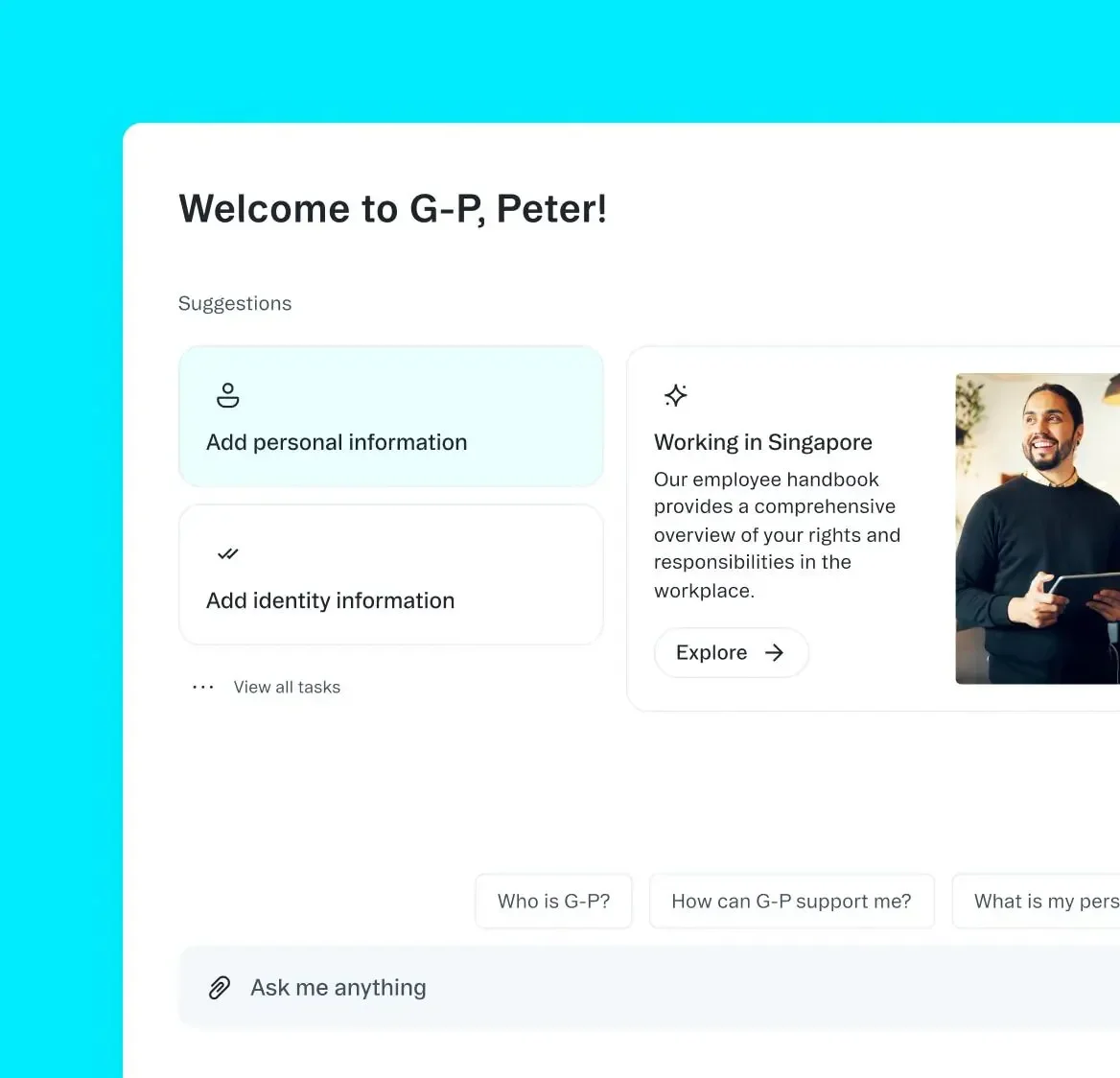
The differences that actually affect your operations center on five decision points. Each reflects the platform-versus-premium philosophical divide.
Best for Pricing
Deel wins on price transparency. Deel publishes EOR from $599/month with automatic volume discounts at 20+ employees, so Finance can model the cost before talking to sales. G-P pricing is custom-quoted with no public figure; it sits at the premium end, reported well above Deel, and is only confirmed through a sales conversation (a 25% platform-fee promotion is currently advertised).
The premium buys more than a higher line item. G-P bundles in-house legal depth, proactive compliance monitoring and high-touch account management that cost extra or sit self-serve with Deel. The honest catch is budgeting: you cannot price G-P without a quote, and setup costs and any deposit surface late.
When your Finance team models the first year, the question is not which sticker is lower (Deel's is) but whether G-P's service depth earns the premium for your markets.
Best for Compliance
G-P wins on compliance depth. It runs 100+ wholly owned entities and places the large majority of hires (reported around 95%) on those entities, so in most markets it controls the employment relationship directly rather than through a partner. Beyond its owned footprint it uses partners to reach 180+ countries, the same hybrid every broad EOR runs, but its owned share is deeper than most. Its Global Compliance Engine applies local labour law in real time and it generates locally compliant contracts in 180+ countries.
On UK contractors specifically, G-P Contractor automates IR35 and misclassification classification checks and produces vetted documents, but its terms place misclassification liability on the client. Deel sells a Contractor of Record at $325/month that actually assumes that liability. So G-P gives you better classification tooling; Deel gives you a product that carries the risk for you. Either way, hiring a UK worker through the EOR removes IR35 exposure entirely, because the EOR is the employer.
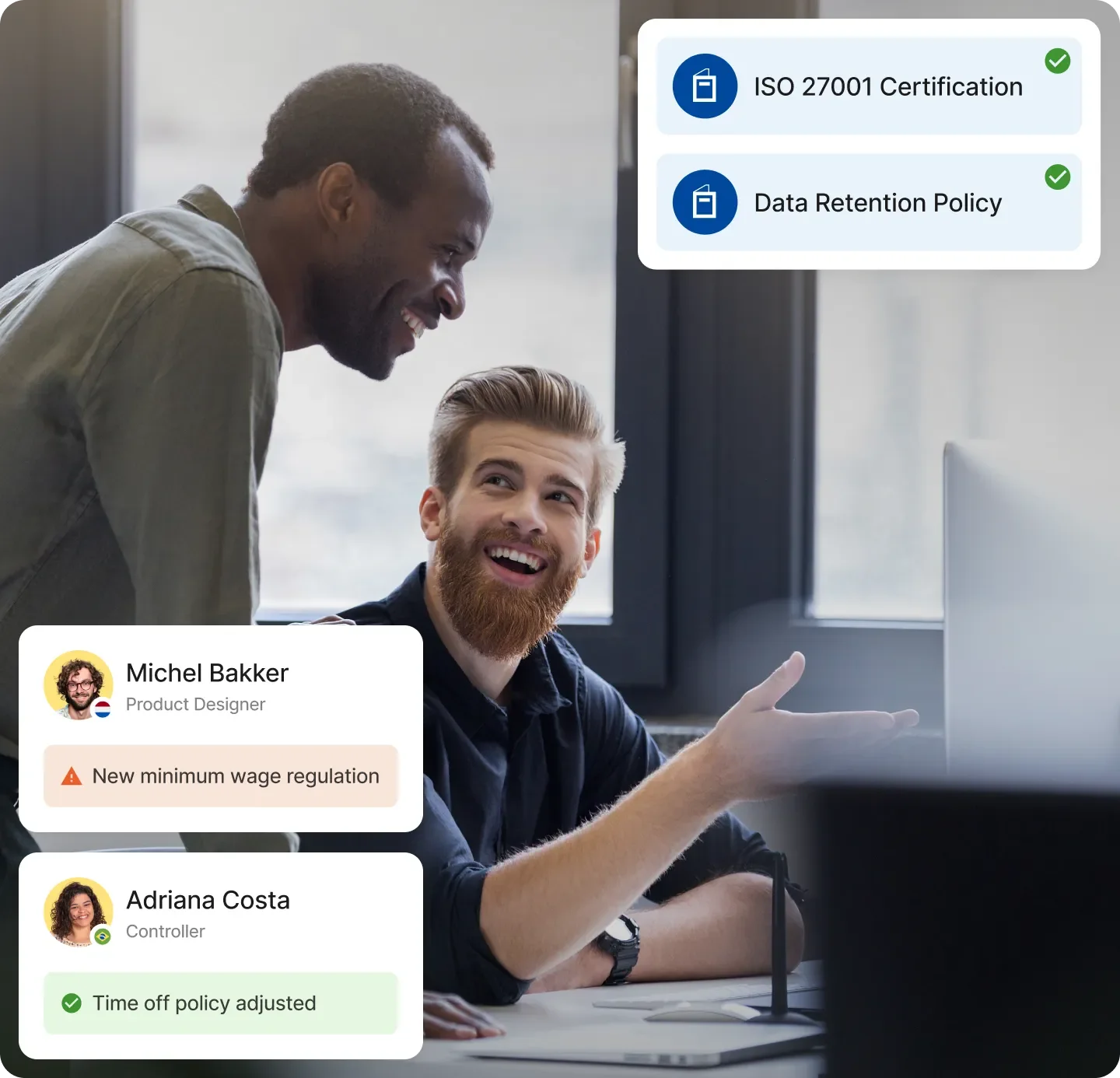
On data and security the two are level: both are GDPR-compliant, SOC 2 audited and ISO 27001 certified, and Deel applies Standard Contractual Clauses for cross-border transfers. This is table stakes at the enterprise end, so treat it as a baseline both clear rather than a differentiator.
Best for Country Coverage
It is close, with different shapes. Deel covers 100+ countries for EOR, 150+ for contractors and runs global payroll in 130+ on a native engine live in 50+ markets. G-P covers 180+ countries for EOR and 190+ for contractor payments, with the deeper owned-entity base underneath. If your target list is mainstream, both reach it; if it includes hard jurisdictions where you want the provider's own entity rather than a partner, G-P's owned share is the safer bet, while Deel's edge is breadth of product across the same map. The decision rule: if your priority list includes hard jurisdictions, ask both for a country-by-country confirmation of owned versus partner before you sign.
Best for Support
Different service philosophies. Deel runs 24/7 live chat and email with fast median response, and assigns a dedicated Customer Success Manager on its Enterprise tier. G-P leans on named account managers, compliance advisors and audit documentation, backed by G-P Assist, its AI tool for round-the-clock compliance answers. The catch on G-P is consistency: some users report ticket-led support without an easy direct phone line, so if guaranteed live escalation matters, press for the named contact and channels in your contract. Net: pick Deel if you want a fast, evidenced median response across time zones, G-P if you want a named human who owns your account and will go deep on compliance.
Best for Integrated Workforce Management
Deel wins clearly here. It is a multi-product platform: EOR, contractor management, global payroll, a free HRIS up to 200 employees, plus immigration, IT asset management, equity tools and an Anytime Pay earned-wage feature, all on one platform with one invoice. G-P is EOR-first, with its Meridian Suite HRIS and Global Compliance Engine bundled into the employment product rather than sold as a broad workforce platform. If you want to consolidate mixed worker types and tooling under one vendor, Deel covers more surface; if you want depth in the employment relationship itself, G-P concentrates there.
What Deel and G-P Actually Deliver
Deel leads with platform efficiency. Pricing is published and transparent.
Onboarding runs through guided workflows in three to five days for standard markets. Compliance comes through automated alerts and a self-service knowledge base.
Support is 24/7 chat-first with two to four hour response times, and Enterprise accounts get a dedicated Customer Success Manager. Integrations include 80-plus HR, accounting and IT platforms. The economics improve with volume because the platform handles the same processes whether you hire ten people or three hundred.
G-P takes a service-led approach. Pricing sits at the premium end.
Onboarding involves dedicated account teams and runs seven to fourteen days, with a compliance review on each hire. Country specialists monitor regulatory changes and brief clients proactively.
Support leans on named account managers and compliance advisors, with G-P Assist providing round-the-clock AI answers on compliance questions. The model is built for guided depth rather than instant live escalation, which is the trade-off you are paying for (see Best for Support above for the detail).
Country coverage looks similar on paper. Execution quality differs in complex markets.
Deel relies on partner entities outside its core owned-entity footprint, which can introduce communication layers when issues arise. G-P owns more entities in regions where partner arrangements typically slow resolution.
The pricing gap is real, but it pays for human capacity rather than software features. Whether that capacity is worth the premium depends on how often you actually need someone to pick up the phone and solve a problem you cannot solve from a dashboard.
Which Should You Choose: Deel or G-P?
The decision framework depends on three factors: your risk tolerance, operational complexity, and budget reality.
Neither provider fits everyone (the trade-offs are too fundamental).
Choose Deel If
- You manage mixed worker types. The integrated platform for EOR, contractors and payroll ends vendor sprawl: one invoice, one platform, unified reporting.
- You want speed and a price you can model upfront. Onboard in days, on published $599 pricing, without a sales conversation.
- You are comfortable with platform-first support (24/7 chat, CSM on Enterprise) rather than a named account manager on every plan.
Choose G-P If
- Compliance certainty is the priority. You want the provider's own entity in most of your markets and audit-grade documentation for regulated industries.
- You are hiring at enterprise scale (roughly 20-50+ employees, often 100+) across complex jurisdictions like Germany, Brazil, France or Japan, where G-P's value improves.
- You want a named account manager and active compliance guidance, and will accept a custom quote and a premium to get it.
Consider an Alternative If
- You want owned-entity coverage without G-P's premium: Remote is owned-entity-first (owns entities in ~90 markets, vetted partners beyond) at published $599-699 pricing.
- You need the deepest payroll analytics and payments: Papaya Global leads on consolidated multi-country payroll intelligence.
- Budget is the hard constraint: lower-cost EORs exist with narrower coverage and lighter support.
Our Editorial View on Deel vs G-P
The choice between these two providers is not about which is “better.” It’s about which trade-off matches your team. Tooling speed and price clarity sit on one side. Service depth and active compliance guidance sit on the other.
If your HR team is confident running global hires with light support, the platform-first model saves money and time. If you are entering markets where you do not have local knowledge, paying for human expertise costs less than fixing a compliance failure later.
What Are the Best Alternatives to Deel and G-P?
The Deel versus G-P decision represents two poles of the EOR market. Several alternatives offer different trade-offs that might better match your specific needs.
Remote.com
For intellectual property certainty: Remote is owned-entity-first, owning entities in around 90 markets and using vetted partners beyond to reach 180+. Its IP protection is strong, with localised invention-assignment agreements.
Pricing is published at $599-699/month, broadly level with Deel and below G-P's custom premium. The key advantage: a deep owned-entity base at a transparent price you can budget without a sales call.
Best for companies that want owned-entity depth and IP clarity without G-P's quote-based premium.
Papaya Global
For payroll analytics and payment depth: Papaya leads the category on consolidated multi-country payroll intelligence, with real-time labour-cost analysis and predictive workforce planning, plus licensed J.P. Morgan payment rails. If Finance needs a single view of employer cost across many entities before it will sign off on headcount, Papaya's analytics layer is the strongest here.
EOR is a flat $599, matching Deel, so you are choosing Papaya for the payments and analytics moat rather than a lower seat price. Best for large, payroll-heavy organisations; less suited to small, contractor-heavy teams.
Velocity Global
For high-touch service in complex markets: Velocity Global (now operating as Pebl) pairs EOR with hands-on advisory and a strong owned-and-partner footprint, positioned for enterprises that want guidance through tricky jurisdictions rather than a self-serve platform. It overlaps G-P on the service-led, compliance-heavy end of the market.
Best for teams that value a consultative relationship and are weighing G-P but want to compare another premium, service-first option.
Check current pricing and plans
Open each provider to compare current pricing, plans, and setup details.
Provider links may be affiliate links where programmes are live.
Deel vs G-P: Frequently Asked Questions
How do Deel and G-P handle employee terminations differently?
G-P manages terminations through their local HR teams with full administrative support included in monthly fees. Deel provides termination workflows through the platform but may require coordination with local partners in non-owned markets. Complex terminations requiring legal support cost extra with both providers.
Can you switch between Deel and G-P easily?
Switching requires terminating employees under one provider and rehiring under another. This triggers severance costs, new onboarding fees, and potential visa complications. Most companies transition gradually by placing new hires with the new provider while maintaining existing employees until natural transition points.
Which provider works better for equity compensation?
G-P provides more comprehensive equity administration support, including tax optimization strategies and exercise assistance. Deel offers basic equity letter generation and tax withholding but requires more employer administration. Neither fully solves cross-border equity complexity (both require additional legal support for non-standard grants).
How do background check capabilities compare?
Deel integrates with multiple background check providers and automates the workflow for additional fees ($50-200 per check). G-P includes basic background verification in some markets within their service but charges for comprehensive checks. Both require you to define check requirements as standards vary significantly by country.
Is Deel or G-P cheaper for EOR?
Deel publishes a flat $599 per employee per month with volume discounts at 20+ employees, so you can budget before talking to sales. G-P does not publish an EOR price; it is custom-quoted and premium, reported well above Deel, and confirmed only through a sales conversation (a 25% platform-fee promotion is currently advertised). On sticker price Deel is clearly lower and more predictable; the question for G-P is whether its deeper owned-entity footprint and high-touch compliance justify the premium for your markets.
How do Deel and G-P handle UK payroll and IR35?
Both can run compliant UK employment. Deel offers HMRC-recognised UK payroll (PAYE, RTI via its dashboard, pension auto-enrolment and statutory pay) and, through its EOR, removes your IR35 exposure because Deel becomes the employer. G-P generates locally compliant UK contracts and runs the employment through its own entity. On contractors, G-P Contractor automates IR35 classification checks and produces vetted documents, but its terms leave misclassification liability with the client; Deel's Contractor of Record ($325/month) is the option that actually assumes that liability.
Methodology
Whichapp is an independent comparison site for global payroll, EOR, and contractor management platforms. We do not sell these services and do not accept payment for editorial placement. We may earn a commission if you book a demo or request a quote through links on this page. This comparison was produced by our editorial team and was not reviewed or approved by either provider before publication.
Data Sources
- Provider pricing pages for both brands (verified April 2026)
- G2 and Capterra reviews for both brands (Jan–Apr 2026)
- Provider help centre documentation and country guides
- Whichapp provider score composite data (see sources & data)
Research Approach
- Pricing model and total employment cost
- Entity model and compliance infrastructure
- Country coverage depth and quality
- Platform usability and onboarding experience
- Customer support model and response standards
- Verified user feedback from G2 and Capterra
Both providers were assessed across the same six dimensions: pricing model and total employment cost, entity model and compliance infrastructure, country coverage depth and quality, platform usability and onboarding experience, customer support model and response standards, and verified user feedback from G2 and Capterra. Neither provider was engaged for a paid pilot or contract as part of this comparison.
Whichapp Research used in this comparison
- EOR Cost Benchmark: published EOR fee ranges and pricing model disclosure across providers
- EOR vs Entity Break-Even Benchmark: 40-country cost crossover analysis: when EOR becomes more expensive than entity setup