
UK · Payroll & compliance
Moorepay Review
Should you choose Moorepay?
Pricing and coverage reviewed April 2026
Moorepay’s sales pitch is straightforward: hand your payroll to a team that has been doing this since 1966, get a dedicated specialist, and stop worrying about HMRC deadlines.
For many mid-market finance teams, that is a real operational appeal, particularly in 2025 and 2026 when the Employment Rights Act is pushing through changes to SSP, parental leave, and day-one rights that add genuine processing complexity.
The appeal sits alongside friction that the sales materials underplay. Pricing is entirely opaque: every evaluation starts with a demo request rather than a public rate card.
Contract terms, when they surface, include multi-year lock-in and early-exit penalties that multiple customers report discovering only after the signature.
The Trustpilot record (4.4/5, 1,823 reviews, but 8% one-star) tells a consistent story about month-end system lag and charges for administrative tasks the client assumed were included.
We reviewed Moorepay’s product documentation, service tier descriptions, independent review data, and customer feedback to give you the honest version of who this works for.
Our Moorepay verdict
Moorepay earns its market position for stable, domestic mid-market payroll. The compliance infrastructure is real: HMRC-recognised, ISO 27001 and 9001 certified, CIPP Payroll Assurance Scheme re-accredited in 2025. Moorepay states the HMRC recognition and CIPP Payroll Assurance Scheme accreditation on its own payroll page. (Details last checked: 2026-06-30; primary source: moorepay.co.uk)
The 2023 acquisition of Natural HR filled a genuine gap in their HRIS offering, though the integration is still maturing.
The Employment Rights Act readiness programme is among the better resources we have seen from a UK payroll provider, with dedicated webinars, a compliance hub, and expert advisory access.
The honest limit is this: Moorepay works best when your payroll runs are predictable, your headcount is stable, and you never need to push back on contract terms.
If any of those conditions shifts (you want to leave early, you hit an edge case that requires non-standard support, or your headcount changes materially), the commercial structure becomes uncomfortable.
For a People Ops lead presenting a shortlist to Finance, the strength is the credential depth and the managed service model. The risk to flag upfront is the contract: specifically the renewal length and the exit cost, which you should negotiate before signing rather than after.
What is Moorepay?
Moorepay is a UK payroll and HR software provider, founded in 1966 and now part of the Zellis Group alongside enterprise payroll platform Zellis and employee benefits specialist Benefex. The group is owned by Apax Partners, which acquired it from Bain Capital, making it PE-backed.
Moorepay specifically serves businesses up to around 1,000 employees, with the practical sweet spot in the 50–500 range. Moorepay puts its own customer band lower still, stating that the majority of its customers have around 30 to 1,000 employees, so very small UK businesses and large global employers both sit outside its core fit. (Details last checked: 2026-06-30; primary source: moorepay.co.uk)
The service model offers two distinct modes: self-service payroll software (you manage the data, Moorepay handles HMRC compliance infrastructure) and fully managed outsourcing where Moorepay’s team handles calculations, BACS payments, statutory submissions, and year-end reporting.
In March 2023, Moorepay acquired Birmingham-based Natural HR, a cloud HRIS with 250+ customers covering 100,000 employees, to close the gap between payroll processing and broader HR management.
Moorepay’s 500+ staff includes CIPP, CIPD, and NEBOSH-qualified advisers. The service claims 99.9% payroll accuracy, and the CIPP Payroll Assurance Scheme accreditation, re-confirmed in 2025, is a meaningful independent credential rather than a legacy marketing badge.
Who is Moorepay best for?
Moorepay makes most sense for UK employers who want to exit the payroll execution business entirely.
If your Finance Director is willing to pay a managed service premium to remove HMRC submissions, BACS runs, and P-form generation from the internal workload, and your headcount sits somewhere between 50 and 500, Moorepay is a structurally sensible shortlist candidate.
It also suits organisations where Employment Rights Act compliance is a live pressure.
The 2025 Act’s changes to Statutory Sick Pay eligibility (expanding to 1.3 million low-paid workers from day one), parental leave day-one rights, and related payroll adjustments require system changes and advisory support.
Moorepay has built readiness resources and expert access specifically around these changes, which matters if your internal HR team does not have the bandwidth to absorb them independently.
Sectors with straightforward PAYE payrolls (healthcare, logistics, retail, professional services) are typically the Moorepay customer base. Complex commission structures, multi-country payroll, or large-scale freelance populations are not the design context here.
Who should avoid Moorepay?
Avoid Moorepay if you have fewer than 30 employees. The managed service model is priced for volume, and the setup overhead (five-phase onboarding, dedicated specialist assignment) is not proportionate for a small team.
BrightPay or a bureau service with transparent per-run pricing will serve you better at that scale.
Avoid it if your procurement process requires a published rate card before a business case can proceed. Moorepay’s pricing is entirely bespoke, which means your internal approval process will be gated behind a sales call.
Some Finance teams find that structure frustrating; some find it reasonable given the complexity of payroll outsourcing.
Either way, factor in the time it adds to your evaluation cycle, because the sales call sits on the critical path before Finance will sign off a shortlist.
Avoid it if you have any international payroll requirement. Moorepay is a UK provider (and, they state, soon Ireland). Global workforce management is outside its scope entirely.
You would need a separate EOR or global payroll vendor alongside it, which creates integration and data complexity you probably do not want.
Moorepay pros and cons
Evaluating Moorepay requires separating what the service genuinely delivers from the friction that emerges once you are in-contract. We give the honest version of both.
Strengths worth paying for: The compliance depth is real and independently verified. CIPP Payroll Assurance Scheme re-accreditation in 2025, HMRC recognition, and ISO certifications are not common credentials for SMB-focused providers.
The Employment Rights Act advisory capacity, with a dedicated webinar series, a compliance hub, and qualified adviser access, is a material operational benefit for any employer navigating the 2025 changes.
The dedicated payroll specialist model (named account manager rather than a shared helpdesk) is consistently the most praised element in customer reviews, with individual specialists frequently cited by name on Trustpilot.
Weaknesses that show up operationally: Month-end system lag is the most consistent technical complaint, reported across multiple Trustpilot reviews.
For a managed payroll provider, where your contract premise is that Moorepay handles the execution, system slowdowns at the point of maximum operational importance are a structural problem rather than a minor inconvenience.
The charge model for routine changes (adding contacts, configuration adjustments) contradicts the “no hidden costs” positioning.
The contract lock-in is the commercial risk that deserves the most scrutiny: customers report 3-year renewal terms and early-exit fees equivalent to 12 months of fees, terms that several describe encountering only after signing.
Whichapp view
The Moorepay Trustpilot pattern is telling: 78% five-star, 8% one-star, with almost nothing in between.
That shape suggests a provider where the service is excellent when the account manager relationship works and the payroll runs smoothly, and deteriorates sharply when something falls outside the normal run.
That is a meaningful signal for procurement. The quality of your Moorepay experience is significantly dependent on who your specialist is and whether your payroll profile ever hits a non-standard scenario. Your contract negotiation matters more than your initial quote.
Moorepay pricing
Moorepay does not publish a price list. Every figure here is a third-party estimate, because all pricing is bespoke and gated behind a consultation and quote. That is standard for managed payroll providers at this market level, but it does add friction to multi-stakeholder evaluation processes where Finance expects numbers before approving a shortlist.
Moorepay payroll software pricing: no public rate card
For the self-service payroll software tier, third-party pricing research puts the starting point at approximately £50/month for around 10 employees, scaling to £200+ per month for 100+ employees.
These are indicative benchmarks drawn from published comparisons and review sites, not figures from Moorepay’s own pricing page, which does not exist in public form.
Setup fees are typically £150–300. Adding HR software modules costs extra, estimated at £20–50 per month depending on scope.
Moorepay managed payroll pricing: setup fees and year-end extras
For the Managed Plus outsourced service, per-employee-per-month pricing benchmarks are in the £5–8 range depending on complexity and headcount. Implementation fees for moving to a managed service are typically £500–1,000 one-off. Year-end processing may attract additional charges.
For a bundled payroll and HR solution, indicative costs start around £100/month and can reach £500+/month for larger mid-market organisations.
Is Moorepay expensive?
Moorepay’s managed service carries a real premium compared to transparent self-service competitors like BrightPay, and the value case rests entirely on whether your organisation actually benefits from full outsourcing.
If your team is capable of running payroll but just wants software, you are paying for a service layer you will not use.
Compared to enterprise-grade managed services, Moorepay is competitive for the mid-market tier. The cost per employee for outsourced payroll (£5–8/month) is broadly in line with the market.
The risk is the additional charges for changes, which can erode the unit economics materially over a multi-year contract.
Does Moorepay offer volume discounts? Not by default
Long-term contract commitments sometimes attract discounts, according to third-party pricing research.
Given that Moorepay uses multi-year renewals by default, it is worth negotiating pricing against contract length explicitly during the sales process rather than assuming a discount will be offered unprompted.
Moorepay features
Moorepay operates as an integrated payroll and HR platform for the UK mid-market, with payroll at the core and HR capabilities added progressively through the Natural HR acquisition. Read "integrated" with care: the payroll engine is mature, but the HR side is bolted on and the two are still being stitched together.
Payroll software and managed outsourcing
The payroll engine handles PAYE calculations, RTI submissions (Full Payment Submission and Employer Payment Summary), BACS payment processing, and statutory forms including P45, P60, P11D, and statutory pay documentation. Auto-enrolment pension management is included. Moorepay says its software builds the latest SSP, SMP, and auto-enrolment legislation into its calculations and runs those statutory payments for you by default, so UK statutory pay is handled inside the engine rather than left to your team to compute. (Details last checked: 2026-06-30; primary source: moorepay.co.uk)
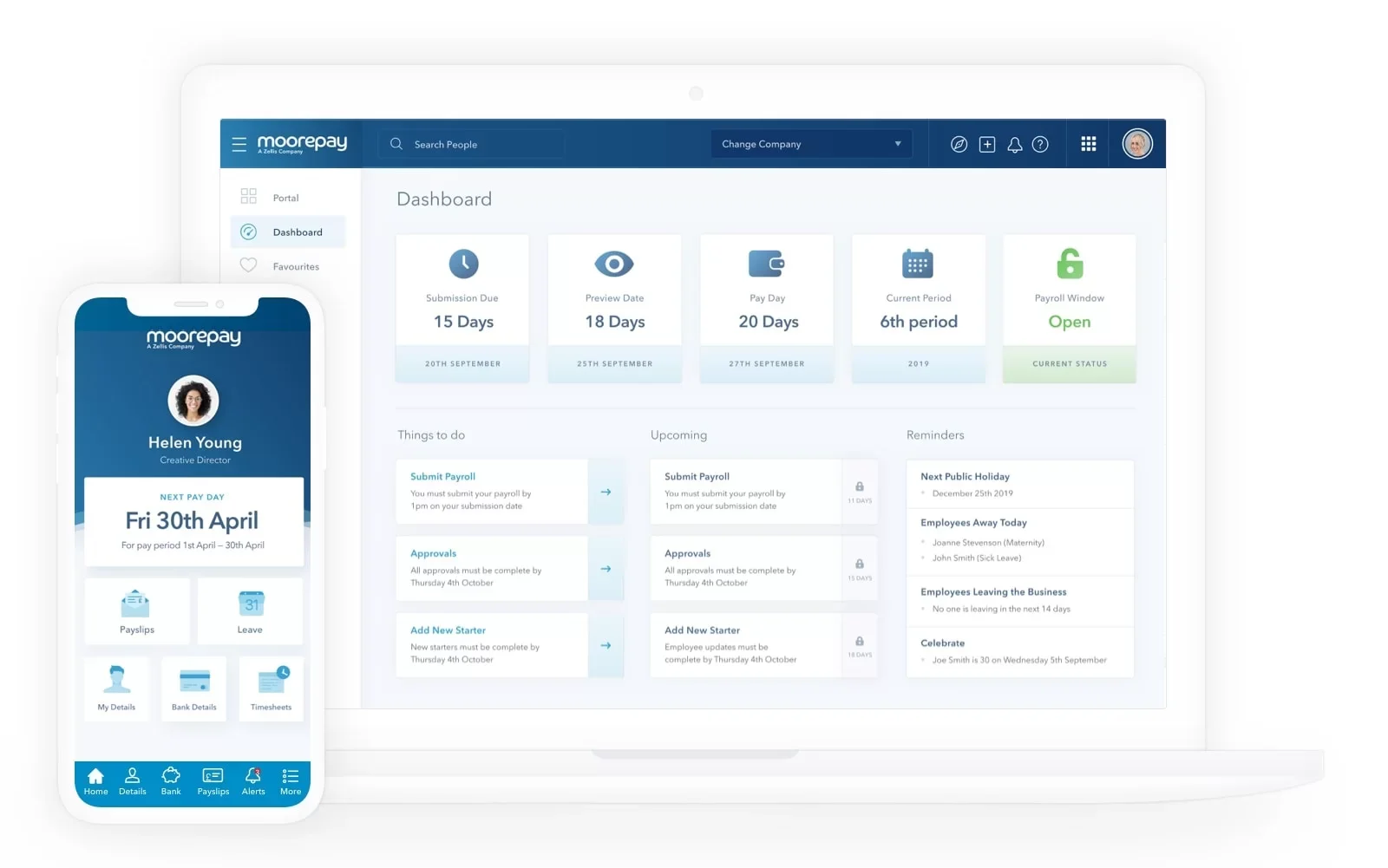
The Managed Plus tier adds a dedicated payroll specialist who owns the end-to-end processing cycle, including validation, HMRC submission, and year-end, removing the execution burden from your internal team entirely.
Onboarding for managed clients runs through five defined phases: Welcome, Setup, Training, First Run, Complete, with a named specialist assigned from the start.
That structure is a meaningful differentiator from shared-service bureau models where onboarding quality depends on whoever picks up the phone.
HRIS: Natural HR integration still maturing
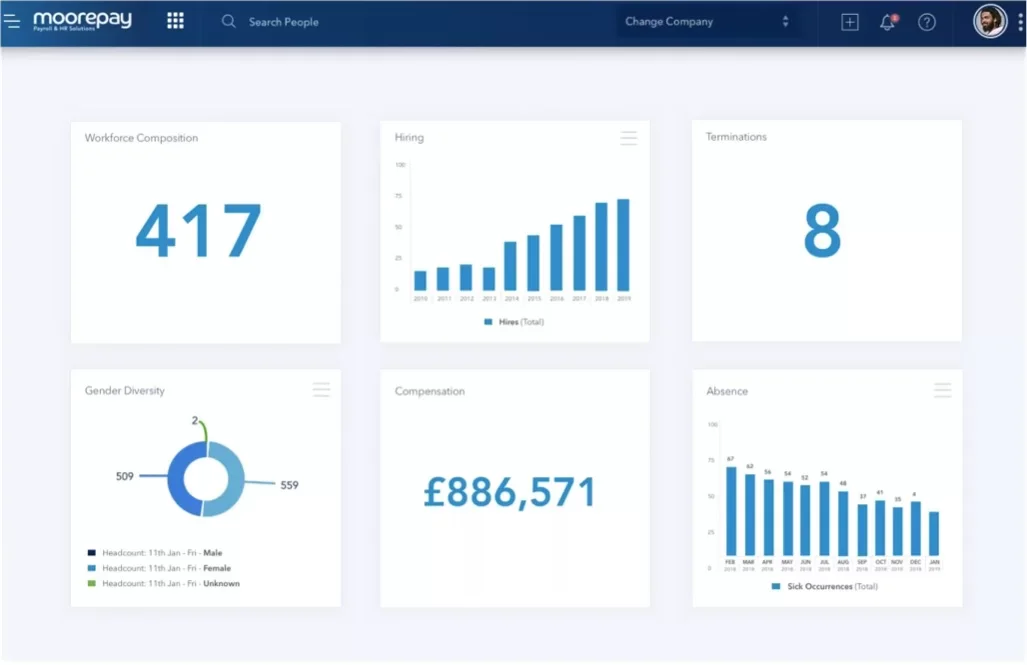
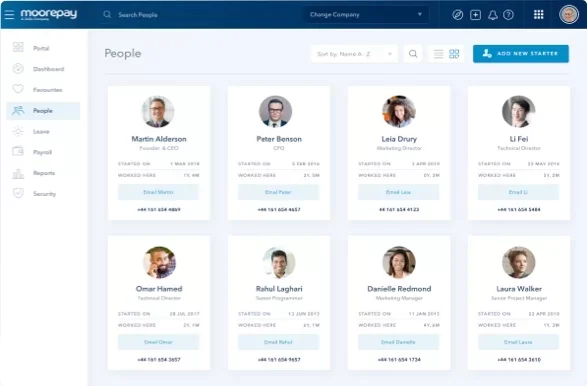
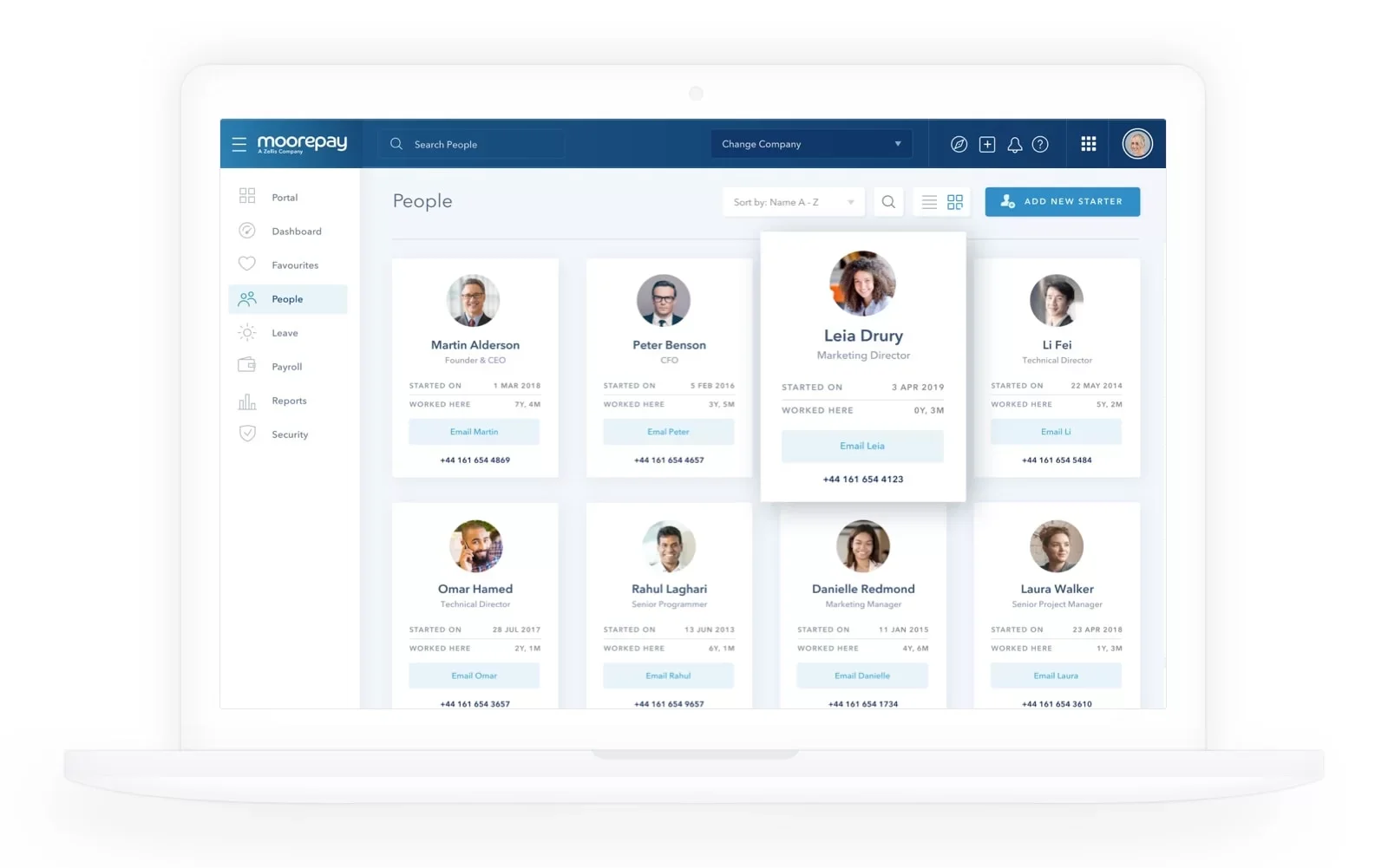
The HR software capability, built on the Natural HR acquisition, covers absence management, employee self-service, onboarding workflows, performance management, pulse surveys, and social recognition.
The payroll-HR data synchronisation (documented in the Natural HR support portal from December 2023) is actively in progress: the platforms share data but are not yet a single unified system.
For most buyers this is workable; for those who need deep real-time payroll-HR integration, it is worth verifying the current state of the sync in your demo.
Compliance and advisory
Moorepay’s compliance layer is among the more substantive in the mid-market category. The CIPP Payroll Assurance Scheme accreditation covers process quality across the payroll cycle.
The employment law advisory service (available by phone, staffed by CIPD-qualified advisers) is a practical operational resource rather than a static document library.
The Employment Rights Act 2025 readiness programme specifically addresses the SSP expansion, day-one parental leave rights, and related payroll system changes, with a webinar series and a compliance hub updated as secondary legislation is confirmed.
For People Ops leads managing compliance workload alongside operational HR, that advisory access reduces the risk of getting something wrong during the 2025–2026 transition period.
It is not a substitute for legal advice on specific cases, but it is a useful first triage layer that most mid-market payroll software providers do not offer.
Is Moorepay trustworthy?
Moorepay’s compliance credentials are independently verifiable, which matters in a category where many providers make compliance claims without external certification.
Ownership and group structure: PE-backed, not independent
Moorepay sits within the Zellis Group alongside Zellis (enterprise payroll, typically 1,000+ employees) and Benefex (employee benefits). The group is owned by Apax Partners, a global private equity firm.
PE ownership in a managed service provider is not inherently a risk factor, but it is a procurement consideration: you are buying into a group with commercial incentives around margin and consolidation.
That context does not change the product, but it is relevant when assessing long-term pricing stability and support investment over a multi-year contract.
Compliance and accreditation
The CIPP Payroll Assurance Scheme is the most relevant credential for a managed payroll buyer: it is an independent quality certification covering payroll processes, accuracy, and staff competency. Moorepay’s re-accreditation in 2025 confirms the standard is being maintained, legacy-claimed.
HMRC recognition is standard for compliant providers; ISO 27001 (information security management) and ISO 9001 (quality management) are meaningful for organisations with data governance or procurement requirements.
Legal and procurement considerations: contract lock-in risks
The commercial risk in Moorepay contracts is well-documented in customer feedback. Multi-year renewal terms (reportedly up to three years) and early-exit charges equivalent to 12 months of fees are the specific terms to negotiate before signature.
Your procurement or legal team should request clarity on: renewal auto-trigger dates, exit notice periods, what constitutes a material change of service, and whether charges for routine account changes are contractually defined or discretionary.
These are standard due diligence questions for any managed payroll vendor; they carry higher stakes here given the specific pattern in the review data.
Moorepay customer reviews
We looked at the Trustpilot record (1,823 reviews, 4.4/5 overall) as the primary customer signal, alongside independent review analysis from published comparison sites.
What customers like
The most consistent praise is for individual account managers, who are frequently named in five-star reviews and credited with going beyond what was contractually required. That is a meaningful signal: it means the relationship model works when it is resourced properly.
Customers also consistently highlight the ease of the platform interface and the professional quality of the onboarding process, specifically the five-phase structure that sets clear milestones.
Common complaints
Month-end system lag is the most frequently cited technical issue, specifically slowdowns and timeouts during peak payroll processing periods. For a managed payroll service, that is the worst possible moment for performance degradation.
Charges for routine account changes (adding contacts, configuration adjustments) appear repeatedly in negative reviews, alongside contract lock-in problems.
One documented case on Trustpilot involved a charity locked into a 3-year renewal term with a 12-month early-exit fee, a situation that could have been avoided with clearer pre-contract disclosure.
Payslip calculation errors are also cited, though these appear to be isolated incidents rather than a systemic pattern.
G2 and Capterra summary
Moorepay’s G2 and Capterra listings are associated with the Natural HR product following the 2023 acquisition. Ratings on those platforms reflect a blend of legacy Natural HR customers and newer integrated reviews; the data is useful context but should be read with that transition in mind.
The Trustpilot dataset (1,823 reviews with a clear pattern) provides the more reliable signal for the core payroll service.
Customer data
Moorepay Trustpilot breakdown (1,823 reviews, April 2026)
5-star: 78% (1,422 reviews); 4-star: 12% (213 reviews); 1-star: 8% (148 reviews); 2-3 star: 2% combined.
The polarisation (very few 2-3 star reviews, a notable 1-star cluster) suggests a provider where experience is strongly shaped by the account manager relationship and whether edge-case payroll scenarios are ever encountered.
Moorepay alternatives
Your switching logic depends on what Moorepay’s model is not giving you: transparent pricing, accounting-software integration, a flexible in/out service split, or room to grow past the headcount ceiling. We map each of those gaps to a specific alternative below.
For transparent pricing and self-service control: BrightPay. It publishes its pricing, runs on an annual licence rather than a rolling managed contract, and suits organisations that want to keep payroll in-house with good software support.
The trade-off is full execution ownership: no managed service layer.
For Sage Accounting integration: Sage Payroll. If your Finance team already runs Sage Accounting, the native integration removes a data reconciliation step that any third-party provider (including Moorepay) requires you to manage.
Sage’s pricing is more transparent than Moorepay’s for comparable functionality. The trade-off is that execution stays on your team, since Sage is software-led rather than a managed service.
For bureau-style outsourcing with a flexible in/out model: Cintra.
Cintra requires 50+ employees (similar to Moorepay’s practical floor) and offers a genuine choice between fully outsourced and hybrid, where your team handles data entry and Cintra takes responsibility for processing and RTI submission.
That flexibility suits organisations that want to retain internal data control without full execution ownership.
For growth beyond Moorepay’s scale ceiling: Zellis. If you are approaching 500+ employees and finding that Moorepay’s managed service is starting to feel constrained, Zellis is the enterprise arm of the same group and the natural upgrade path without switching vendors entirely.
Is Moorepay worth it?
Moorepay is worth it for a specific profile: a UK mid-market employer (50–500 employees) whose payroll is PAYE-domestic, whose Finance team wants the execution off their desk, and who has the procurement appetite to negotiate a contract properly before signing.
The compliance infrastructure, the Employment Rights Act readiness resources, and the named specialist model are real advantages. The pricing opacity, the contract terms, and the month-end platform performance record are real risks.
The question is not whether Moorepay is a capable provider (it is), but whether the commercial structure you agree to protects you when something goes wrong or when your needs change.
Go into the sales process asking for a transparent exit clause, a defined charge schedule for account changes, and clarity on auto-renewal trigger dates, and Moorepay can be a stable long-term managed payroll partner.
Sign on the headline managed service promise alone and revisit the contract only when there is a problem, and the 8% one-star pattern on Trustpilot tells you what that looks like.
See our ranked shortlist of providers, scored for HMRC submission reliability, statutory-pay handling, and pricing transparency. Updated for 2026.
View the shortlist →Moorepay FAQs
How much does Moorepay cost?
Moorepay does not publish a price list. For payroll software, indicative costs are approximately £50/month for 10 employees rising to £200+/month for 100+ employees, with a setup fee of £150–300.
For the fully managed Managed Plus service, indicative PEPM pricing is £5–8 per employee per month, with a one-off implementation fee of £500–1,000.
These figures come from third-party pricing research and are subject to quote variation. All pricing is confirmed via a consultation call with Moorepay’s sales team.
What are the disadvantages of Moorepay?
The most reported disadvantages are: system slowdowns at month-end payroll runs; charges for routine account changes not clearly disclosed upfront; and multi-year contract terms with significant early-exit penalties. There is also no public pricing, which adds friction to procurement processes.
The HR software (Natural HR) and payroll platform are still completing integration following the 2023 acquisition, which may affect buyers who need a fully unified platform today.
Is Moorepay good for small businesses?
Generally, no. Moorepay’s managed service model and pricing structure are calibrated for businesses with 50+ employees. Below that threshold, the setup overhead, implementation fee, and minimum service cost are disproportionate.
Small businesses under 30 employees are better served by self-service payroll tools such as BrightPay, which offer transparent per-run or annual licensing without the managed contract structure.
Does Moorepay handle RTI submissions to HMRC?
Yes. RTI compliance, specifically Full Payment Submission (FPS) and Employer Payment Summary (EPS), is a core part of both the self-service software and the Managed Plus outsourced service.
For background on how RTI works and what UK employers are required to submit, see our guide to Real Time Information reporting.
How does Moorepay compare to Sage Payroll?
Moorepay and Sage Payroll serve similar mid-market UK businesses but with different value propositions. Moorepay’s Managed Plus removes payroll execution from your team entirely; Sage Payroll is primarily software-only, with execution remaining in-house.
Sage has a pricing transparency advantage: its tiers are published.
Moorepay has a compliance depth advantage: the CIPP Payroll Assurance Scheme accreditation and employment law advisory are harder to replicate in a software-only model.
If your team is already embedded in the Sage accounting ecosystem, Sage Payroll’s native integration removes a reconciliation step that any third-party tool (including Moorepay) requires you to manage separately.
What is the Employment Rights Act 2025 and does Moorepay support it?
The Employment Rights Act 2025 received Royal Assent in December 2025.
Key payroll implications include: SSP eligibility expanding to approximately 1.3 million low-paid workers from day one (removing the Lower Earnings Limit and waiting period), day-one parental leave rights, and changes to paternity leave calculations.
Moorepay has built an Employment Rights Act readiness programme covering these changes, including webinars, a compliance hub, and adviser access.
Whether those resources fully address your specific payroll configuration depends on your workforce profile; the programme is a useful starting point, not a guarantee of compliance.
How we reviewed Moorepay
We reviewed Moorepay’s product documentation, service tier pages (including the Managed Plus service description and pricing guidance pages), company information including the Zellis Group structure and Apax Partners acquisition, and compliance credential documentation.
Customer review analysis drew on Trustpilot (1,823 reviews as at April 2026), with thematic analysis of positive and negative review patterns.
Third-party pricing benchmarks were drawn from payrollprices.com, Creative.onl, and Expertsure. We also reviewed Moorepay’s Employment Rights Act readiness content and the CIPP’s Payroll Assurance Scheme documentation.
Whichapp is an independent comparison site. We do not sell payroll software or services. Some links on this page may be affiliate links, and this does not influence our editorial assessment.
We did not conduct a live implementation, employee payroll run, or direct platform test for this review; the assessment draws on published sources and customer evidence only.
Pricing figures are third-party estimates, not Moorepay’s published rates, and should be verified with Moorepay directly for your specific situation. For a broader view of managed payroll outsourcing options, see our guide to UK payroll outsourcing.
For the underlying PAYE and employer obligations framework, see our guides to PAYE explained for employers, employer National Insurance contributions, and UK payroll compliance.